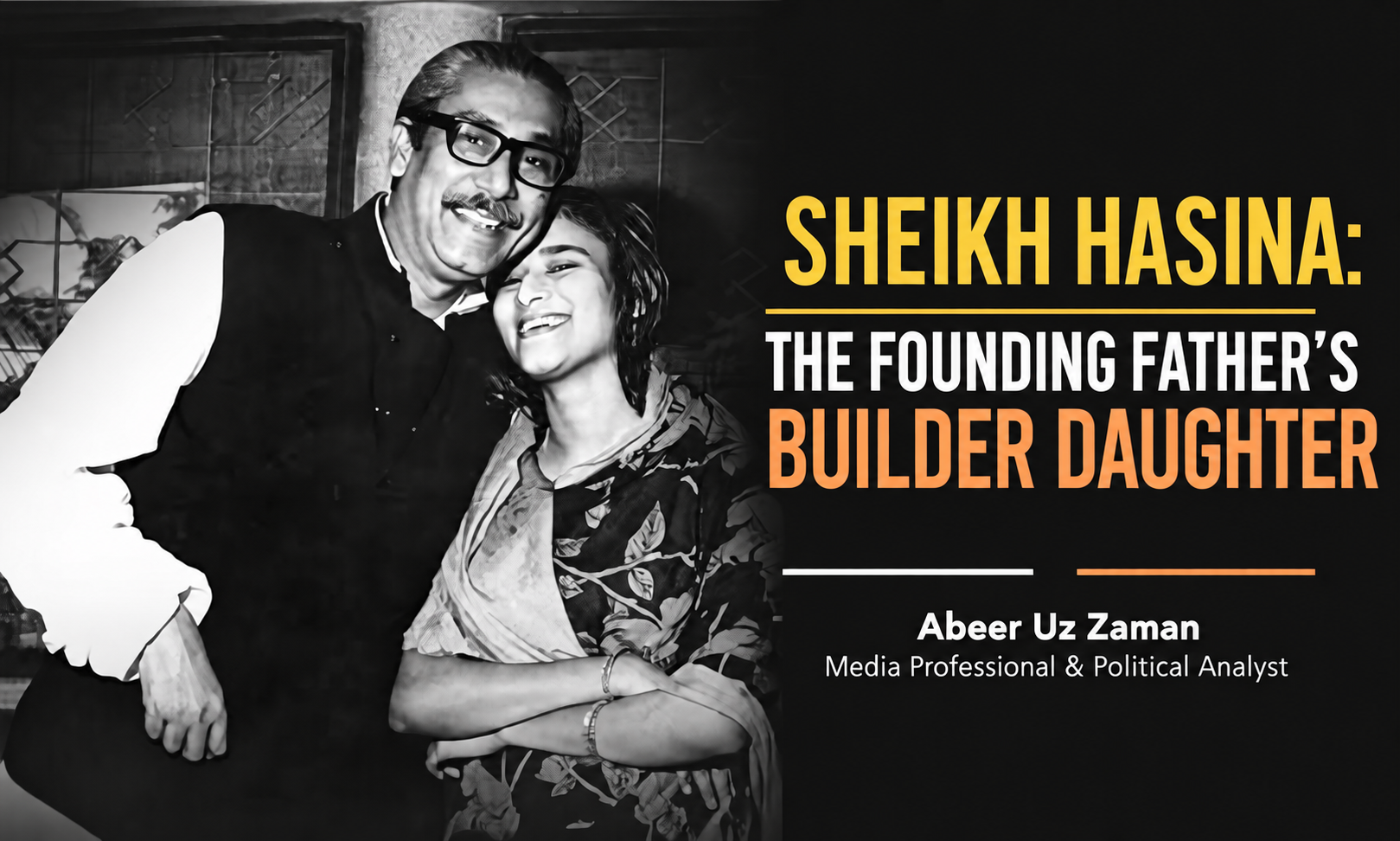
Sheikh Hasina :The Founding Father’s Builder Daughter
On her birthday, a personal reflection on inheritance, survival, state-building, crisis, and the woman I learned to call “Apa” long before I learned to examine governments through documents.
There are two ways I have known Sheikh Hasina.
The first came long before journalism taught me to distrust easy narratives. I knew her through political memory, through the history inherited by a generation, through my own years around student politics, and through a remarkably ordinary Bengali word used for an extraordinarily powerful woman: Apa.
The second came later.
It came through documents.
Through laws and government records. Through budgets, statistics, project papers and Right to Information applications. Journalism taught me to look for the record behind the statement, the expenditure behind the project, the law behind the authority and the evidence behind political memory. It taught me something more uncomfortable too: affection is not evidence. If a claim is true, it should be able to survive the document.
Strangely, those two ways of seeing Sheikh Hasina have never completely cancelled each other out.
Instead, they have left me with a more difficult question. What happens when the woman you once knew emotionally as Apa becomes someone you later learn to examine professionally through the record of the state?
On her birthday, I find myself returning to that question.
And the answer does not begin with the Prime Minister.
It begins with a daughter.
A daughter who left home with a family and, while abroad, discovered that there was almost no family left to return to.
Everything else came later.
The Inheritance Was Not a Throne. It Was a Tragedy.
The language of “political dynasty” can make inheritance sound comfortable. It suggests a famous surname, an established organisation, inherited networks and an easier road to power. But if one wants to understand what Sheikh Hasina actually inherited, that is an inadequate place to begin.
Her first inheritance was absence.
On 15 August 1975, Sheikh Hasina was outside Bangladesh. Her father, Sheikh Mujibur Rahman, was killed. Her mother, Sheikh Fazilatunnesa Mujib, was killed. Her brothers were killed. Other members of the family were killed with them. Sheikh Hasina and her younger sister, Sheikh Rehana, survived because they were abroad. She would remain outside Bangladesh for years before returning in May 1981.
There is an enormous political history attached to 15 August. But beneath political history lies something more primitive and more human: two daughters learning that the people who constituted “home” were almost all gone.
It is difficult to comprehend that loss if we begin with the motorcade, the podium or the office of Prime Minister. Begin instead with a young woman in another country receiving news from home. Not the death of one parent. Not one sibling. Almost the entire centre of a family.
And then there is the historical cruelty of where it happened. The catastrophe occurred in the very country whose creation had consumed her father’s political life.
Power acquired decades later cannot reverse such a morning. No election victory brings a mother back. No bridge restores a brother. No official residence reconstructs a family home after the people who made it a home are gone.
Whatever else Sheikh Hasina later became, that absence travelled with her.
The Politics of Returning
Sheikh Hasina had already been politically active as a student, so it would be historically wrong to portray 1975 as the moment politics first entered her life. What changed after 1975 was the meaning politics carried.
Years of exile followed. In 1981, while still abroad, she was elected president of the Awami League. On 17 May that year, she returned to Bangladesh.
The older I become, the more interesting I find the act of returning itself.
She could have built another life elsewhere. After what had happened to her family, walking away would have been comprehensible at a purely human level. Bangladesh had already taken from her more than most people could imagine losing.
She returned anyway.
We usually measure political courage through elections, speeches, imprisonment or confrontation. Sometimes it can also be geographical. Sometimes the consequential decision is simply to go back.
She returned to the country where her father’s political life had achieved its greatest triumph and where her family had suffered its greatest catastrophe. From then on, Bangladesh would no longer be merely the country of her father’s history. It would become the arena in which almost all of her own political history would unfold.
A Life Lived Under the Shadow of Danger
What followed was not a smooth journey from famous surname to state power.
There were years of opposition politics, anti-authoritarian movements, arrests, periods of detention and repeated political violence. Contemporary and official chronologies record multiple detentions during the military-rule years. Much later, during the military-backed caretaker government, Sheikh Hasina was arrested on 16 July 2007 and taken to a special sub-jail on the Jatiya Sangsad premises. She remained detained for nearly eleven months and was released on 11 June 2008.
There were also repeated attacks and reported assassination attempts across her political life.
One has to be careful when writing about such a long and contested political career. Numbers of alleged assassination attempts can vary depending on what is counted as an “attempt,” and political biographies sometimes turn history into mythology by repetition.
But one event requires no mythology.
It happened in daylight, in front of journalists, cameras and thousands of people.
21 August 2004.
21 August: When People Became a Wall
Sheikh Hasina was addressing an Awami League rally on Bangabandhu Avenue in Dhaka when grenades tore through the gathering.
Within moments, an ordinary political rally became a landscape of explosions, smoke, blood and people trying to understand where the next grenade might land. Twenty-four people ultimately died and hundreds were injured. Ivy Rahman, a senior Awami League leader, was catastrophically wounded and died several days later.
Numbers preserve the scale of tragedy. They do not preserve the sensation of being inside it.
When an explosion happens nearby, a human body does not wait for ideology. Instinct says: get down, find cover, move away, survive.
Yet something different happened around Sheikh Hasina.
Contemporary reporting recorded Awami League activists and security personnel forming a human shield around her. Witness accounts described former Dhaka mayor Mohammad Hanif and others crouching around her on the truck. Other accounts identify Abdullah Al Mamun, Nazib Ahmed and Mofazzal Hossain Chowdhury Maya among those involved in shielding and moving her toward her vehicle. Her personal security staff member Mahbub Alam was killed. After she reached her vehicle, it was fired upon.
That scene has always seemed larger to me than the vocabulary normally used to describe political loyalty.
Loyalty is easy to declare when nothing is happening.
It means something different when the next explosion may occur exactly where you are standing.
There was no committee meeting in those seconds. No manifesto to consult. No time to calculate whether remaining beside another human being was rational.
There was only the most primitive choice imaginable: move away from danger, or remain beside the person in danger.
Some remained.
They answered with their bodies.
And there is a haunting symmetry between 1975 and 2004.
In 1975, Sheikh Hasina survived because she was thousands of kilometres away when death reached her family.
In 2004, she survived while death was immediately around her—and other people placed themselves between her and it.
The first survival left her almost without a family.
The second revealed another kind of relationship that decades of political life had created.
From Survivor to Prime Minister
Four years later, the political landscape changed again. The Awami League-led alliance won the December 2008 election, and Sheikh Hasina returned to the office of Prime Minister in January 2009.
At this point her biography changes character.
The earlier chapters can largely be narrated through inheritance, survival, opposition and the struggle for political power. The next chapter is about what happens when a leader possesses something unusually scarce in Bangladeshi politics:
time.
Development requires time in a way that campaign promises do not. A government can announce a bridge in an afternoon. Financing it, acquiring land, designing it, constructing it and integrating it into an economy may take years. Power plants, railway systems, administrative digitisation and nationwide social programmes require institutional continuity.
Sheikh Hasina’s long period in government provided that continuity.
And slowly, the survivor became associated with something else.
Building.
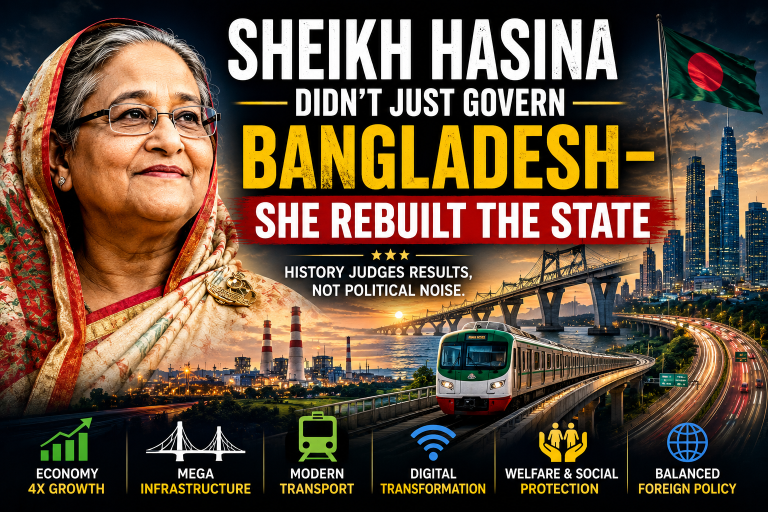
The Builder Daughter
To understand the scale of change, it is necessary to remember the Bangladesh of 2009 rather than look backward only from the Bangladesh that later emerged.
Electricity shortages shaped everyday life. Load-shedding was not an occasional inconvenience; it structured the routines of households, students, factories and businesses. Transport infrastructure struggled to serve a rapidly expanding economy. Much of government still meant paper, physical offices, signatures, queues and repeated journeys through bureaucracy.
The Bangladesh visible fifteen years later was materially different.
World Bank data put electricity access at 99.5 percent of the population in 2024. The institution’s broader account of Bangladesh’s development notes how rural electrification and solar systems extended productive hours, enabled children to study at night and supported economic activity in communities that had previously depended on kerosene.
But 99.5 percent is just a number until we translate it into life.
Electricity is the light under which a student reads.
It is the refrigerator preserving medicine.
It is an irrigation pump in a field.
It is the garment production line operating another shift.
It is the welding machine in a small workshop, the fan above a hospital bed, the mobile tower connecting a village, the computer in a small business.
This is what development statistics often conceal: they are ultimately descriptions of changed human routines.
The Padma Bridge can be understood the same way.
From a distance, a bridge is concrete, steel and engineering. From the perspective of ordinary life, a bridge is time.
The World Bank’s modelling before the bridge opened projected significant reductions in travel time and transport costs for the southwest, with potential effects on wages, population distribution and economic activity in areas newly connected more efficiently with Dhaka.
That is what a bridge does when it becomes part of an economy. A farmer’s produce reaches a market sooner. A bus journey becomes predictable. A business can reconsider where it stores goods. A student can imagine travelling between home and university differently. Distance on the map has not changed, but economic distance has.
Dhaka Metro Rail changed another expectation. For generations of residents, congestion had become so normal that people organised their days around the possibility of becoming trapped in traffic. A modern urban railway did not solve Dhaka’s transport crisis, but it changed the category of solution Bangladesh was willing to attempt.
The Karnaphuli Tunnel, expressways, expanded roads and other large infrastructure projects contributed to the same transformation.
The country was not merely acquiring structures.
It was acquiring a different idea of scale.
When Development Becomes Ordinary
There is a strange paradox at the heart of successful development.
Eventually, people stop noticing it.
A child growing up crossing the Padma Bridge will never experience that bridge in the way someone who spent years waiting for ferries experienced its opening.
A teenager who assumes electricity will be available tonight cannot emotionally reconstruct a childhood organised around load-shedding.
A commuter who uses a metro regularly will eventually become annoyed when the train is late rather than amazed that the train exists.
That is not ingratitude.
That is what happens when development becomes ordinary.
Yesterday’s achievement becomes tomorrow’s baseline.
And perhaps one of the most consequential changes during Sheikh Hasina’s long period in government was therefore not any single megaproject. It was the transformation of expectation.
A generation began expecting electricity.
Expecting connectivity.
Expecting large bridges to be completed.
Expecting online services.
Expecting Bangladesh to attempt projects that previous generations associated with wealthier Asian states.
Once a population has seen the state accomplish something it previously considered improbable, the next improbable thing becomes slightly easier to demand.
That is how development changes politics without appearing on a ballot paper.
She Did Not Only Build Concrete
The phrase “Builder Daughter” becomes too narrow if it refers only to bridges, tunnels, railways and electricity.
Some of the most consequential infrastructure of a modern state cannot be photographed.
It exists in laws.
Databases.
Administrative procedures.
Procurement systems.
Institutions.
And rights.
For me, one example is especially personal.
The Right to Information Act, 2009.
The Act was enacted on 6 April 2009. It established a statutory framework for citizens to seek information from public authorities and created the Information Commission as an independent statutory body. Section 4 states the citizen’s right to obtain information from an authority, subject to the law.
For most people, that may sound like another piece of legislation.
For an investigative journalist, it changes the relationship between citizen and state.
The Law I Now Use
Years after that law entered the statute book, I found myself using it.
When I submit a Right to Information application today and ask a public authority to produce an environmental clearance, an enforcement record, an official register, a letter or another government document, I am not simply asking an official for a favour.
I am invoking a right.
That distinction is enormous.
Journalism taught me to distrust convenient narratives and ask for primary records. Yet one of the legal instruments that enables me to do precisely that became law at the beginning of Sheikh Hasina’s 2009 government.
There is something almost beautifully democratic about that contradiction.
A government creates an accountability mechanism.
Years later, a journalist can use that mechanism to scrutinise the state itself.
The instrument should not care whether the resulting document embarrasses a ministry, contradicts an official or challenges a government narrative. That is precisely the point of an institution: if it works, its usefulness eventually becomes larger than the immediate political interests of the people who created it.
A road is physical infrastructure.
A functioning right to information is accountability infrastructure.
Both are ways of building a state.
Digital Bangladesh Was More Than a Slogan
“Digital Bangladesh” eventually became such familiar political language that it became easy to hear it merely as branding.
But the more interesting story is what happened when the word “digital” stopped sounding futuristic.
Government procurement offers one measurable example. Bangladesh’s e-Government Procurement system moved large parts of public procurement online; by 2022, the World Bank reported that around 80 percent of public procurement expenditure was being processed through e-GP, compared with only 2 percent in 2017. The system also preserved procurement records digitally for audit and allowed online submission, evaluation and complaint tracking.
That sounds technical until one thinks about what the old system required: paper, physical presence, transportation of documents and opportunities for interference simply because a bidder had to appear somewhere carrying a file.
Digitisation changes that relationship.
The same transformation happened in ordinary financial life. Mobile money and digital accounts increasingly became part of how Bangladeshis send, receive and store money. Something that now feels utterly mundane—a worker in Dhaka sending money to a parent in a village within seconds—represents an extraordinary compression of distance.
This is often how technological transformation succeeds.
Eventually, people stop calling it technology.
It simply becomes life.
The Crisis Manager
Then came a crisis no national development plan had scheduled.
COVID-19 did not test Bangladesh alone. It tested almost every government on earth at the same time.
Flights stopped. Factories closed. Schools shut their doors. Supply chains fractured. Families lost income. Hospitals faced a disease doctors themselves were still learning to understand. Governments had to make decisions before certainty was available.
Bangladesh suffered deeply. The World Bank later assessed that the pandemic slowed growth and reversed the country’s poverty-reduction trend for the first time in two decades. But by the first half of FY2021 factories had reopened, exports had rebounded and early labour-market recovery was visible in Dhaka and Chattogram.
Then came vaccination.
In April 2021, Bangladesh signed three World Bank financing agreements totalling $1.04 billion for pandemic response, vaccination, digital procurement and economic recovery. Of that, $500 million in additional financing was intended to help vaccinate approximately 54 million people and support vaccine procurement, storage and deployment. The World Bank at the time also pointed to Bangladesh’s fiscal stimulus and social-protection programmes as part of the response.
Again, 54 million is simply a number until one imagines what administering it means.
Vaccination on that scale means doses, refrigeration, transport, registration, nurses, doctors, local centres, databases and millions of individual encounters between a citizen and the health system.
Citizens see an announcement.
A state confronts millions of transactions behind it.
And COVID was not the only external pressure during those years. Bangladesh also had to contend with global commodity and energy shocks, recurring climate disasters and the demands created by hosting a very large Rohingya refugee population.
Governing in such conditions is not simply about executing a development plan.
It is about keeping several systems functioning simultaneously when events outside the country keep changing the assumptions on which that plan was built.
The Most Important Project May Have Been Confidence
Looking backward, I sometimes wonder whether one of the most consequential products of the Hasina era was something that cannot be photographed.
Confidence.
Poor countries do not suffer only from shortages of money. They can also suffer from shortages of institutional imagination.
A bureaucracy accustomed to small projects becomes cautious about large ones. A government accustomed to failure learns to avoid risk. Citizens accustomed to promises without completion lower their expectations.
The reverse can happen too.
One completed project teaches officials how to administer another.
One digital system creates expertise for the next.
One emergency creates administrators who have experience when another arrives.
One project previously described as impossible makes the next improbable project slightly easier to imagine.
This is how state capacity accumulates.
And perhaps national confidence does too.
The Father Founded. The Daughter Built.
No country is founded by one person alone.
And no country is built by one leader alone.
Millions participated in Bangladesh’s Liberation War and the political struggle that preceded it. Millions more built the country afterwards. Farmers produced its food. Garment workers powered its exports. Migrant workers sent earnings home. Engineers designed infrastructure. Labourers physically built it. Teachers educated generations. Doctors treated them. Entrepreneurs invested. Civil servants administered the machinery of the state.
Bangladesh was built by Bangladeshis.
Political leadership occupies a different place in that story.
It sets direction. It chooses priorities. It decides which risks the state will accept and which ambitions the bureaucracy will be asked to pursue. And when leadership lasts long enough, those choices can accumulate into a recognisable era.
That is where I see the distinction between father and daughter.
Sheikh Mujibur Rahman belongs to the central political story of Bangladesh becoming an independent state.
Sheikh Hasina belongs to a long and consequential chapter in the story of what that state attempted to build afterwards.
The father became inseparable from the founding.
The daughter became inseparable from an era of building.
The Founding Father.
The Builder Daughter.
And Yet, Before Everything Else, She Was a Daughter
After all the statistics, perhaps this is where I return.
Because politics has a habit of turning human beings into offices.
Prime Minister.
Leader of the Opposition.
Party President.
Prisoner.
Exile.
These words describe political circumstances.
They do not describe an entire human life.
Remove the motorcade for a moment. Remove the security cordon, the cabinet room, the official residence and the podium.
What remains?
A daughter.
A sister.
A mother.
A woman in the later years of a life in which national history repeatedly entered the most private spaces imaginable.
No amount of political power can make 15 August 1975 unhappen.
That is why an old Bengali truth about loss reaches somewhere political analysis cannot: the person who has lost knows the weight of losing.
We can calculate GDP.
We can calculate megawatts.
We can calculate kilometres of road.
There is no unit for the weight of an empty family home.
The Human Shield, Twenty-Two Years Later
And then my mind returns to 21 August.
Not because history repeats itself literally. It does not.
But because certain images refuse to disappear.
A rally.
An explosion.
People running.
And then several people moving in the opposite direction—toward one woman.
Twenty-two years later, almost every political circumstance surrounding Sheikh Hasina is different. She is outside Bangladesh. Her fifteen-year continuous period in office is over. Her party is barred from political activity under the current order. She also faces a death sentence imposed in absentia over the 2024 crackdown, which she disputes. In July 2026, she told Reuters that she intended to return around December with senior party colleagues and surrender to the authorities despite the prospect of imprisonment or death.
Those facts belong to the political and legal history now unfolding. They should not be romanticised into a prediction about what comes next.
But they make the memory of 21 August unexpectedly powerful again.
Because the historical question created by that human shield remains:
What kind of political relationship makes a person move toward a leader when every survival instinct says to run away?
Political science can offer theories—organisation, ideology, charisma, identity, collective memory.
Perhaps all contain part of the answer.
But the people around Sheikh Hasina on 21 August had no time to formulate a theory.
They had seconds.
And some stayed.
That image tells us something about the relationship between Sheikh Hasina and a section of the political movement around her that election results and opinion surveys never could.
What Survives a Government
This may ultimately be one of the most useful questions to ask of any long period in power.
Not simply: how powerful was the government while it governed?
But: what continues existing after its power ends?
A bridge survives an inauguration.
A railway survives an election.
An electricity connection survives a cabinet.
A database survives a minister.
A statute can survive the government that enacted it.
An institution can eventually be used by people who disagree with the politicians who created it.
That is the difference between occupying the state and leaving an institutional footprint upon it.
And there is another paradox here.
Successful development often erases the memory of the problem it solved.
Once the bridge exists, the ferry queue becomes somebody else’s memory.
Once electricity becomes normal, load-shedding becomes a story parents tell their children.
Once government services become digital, carrying a thick folder from office to office begins to sound strangely archaic.
Eventually, people stop remembering transformation as transformation.
They simply call the result normal.
History Is Longer Than Power
Power is temporary.
Every government ends.
Every parliament eventually dissolves.
Every official residence eventually receives another occupant.
Posters fade. Slogans change. Crowds go home. Political arguments that once seemed capable of consuming an entire country eventually become paragraphs in a history book.
But consequences remain.
A bridge remains after the inauguration banner is removed.
A railway carries passengers who may have been children when it was approved.
An electricity connection serves a family that may have no memory of the years before it arrived.
A journalist invokes a statute without thinking every morning about the politicians who passed it.
That is the peculiar immortality of state-building.
History does not preserve power. It preserves consequences.
A political figure does not become historically consequential because everyone agrees with them. History has never required unanimity.
Nor does historical consequence erase controversy. The same period can leave infrastructure and institutions while also generating profound disputes about power, accountability and the conduct of the state. Those arguments belong to the historical record too.
But there is a point at which a political figure becomes impossible to remove from the explanation of an era.
Bangladesh’s founding story cannot be told without encountering Sheikh Mujibur Rahman.
And anyone attempting to explain the physical and administrative transformation of Bangladesh during the first quarter of the twenty-first century will repeatedly encounter Sheikh Hasina.
Perhaps that is a more meaningful definition of political immortality.
Not that everybody loves you.
Not that every generation agrees with you.
Not that history stops interrogating you.
But that the history of your country develops a permanent space shaped like your presence.
Apa
I began this essay by saying that there are two ways I have known Sheikh Hasina.
Journalism gave me the second one.
It taught me to look past the podium and ask for the document; past the promise and examine the result; past political memory and search for the record.
It taught me that affection cannot substitute for evidence.
But it never required me to lie about the first.
Before the documents, before the datasets, before the RTI applications, before I learned to interrogate the state for a living, there was a much simpler word.
Apa.
Perhaps maturity is not the elimination of those two identities.
Perhaps it is learning to know when each one is speaking.
The journalist in me looks at records, laws, institutions, infrastructure and measurable change.
The former student activist in me remembers something less measurable.
A word.
Apa.
Prime Minister was an office.
Party President was a position.
Apa was a relationship.
And relationships belong to a different vocabulary than state power.
That is why, after writing about 1975, exile, return, grenades, prison, elections, electricity, bridges, railways, laws, digital systems, a pandemic and fifteen years of continuous government, I do not want to end with any of them.
I think instead of the daughter who survived because she happened to be away when almost her entire family was killed.
I think of the woman who nevertheless came home.
I think of an afternoon in 2004 when grenades were exploding and human beings, with no time to calculate the odds, placed their own bodies around hers.
And I think about the strange mathematics of history.
Power subtracts itself eventually.
The motorcade disappears.
The office changes hands.
The security cordon moves elsewhere.
The portraits come down.
The slogans change.
But history keeps what power leaves behind.
A bridge can outlive the government that built it.
A railway can carry people who were children when it was approved.
An electricity connection can become so ordinary that the next generation forgets there was ever a time without it.
And a law passed by one government can years later sit on the desk of a journalist demanding that the state disclose its own records.
That may be the more enduring measure of political life.
Not how long someone occupied an office, but how much of the country remains impossible to explain without examining the period in which they occupied it.
The father belongs to the story of the state’s birth.
The daughter belongs to a long chapter of what the state became afterwards.
The Founding Father.
The Builder Daughter.
But today is her birthday.
So perhaps neither history nor politics deserves the final word.
Today, no office.
No protocol.
No title.
Just the word I knew before I knew how to read a government file.
Happy Birthday, Apa.