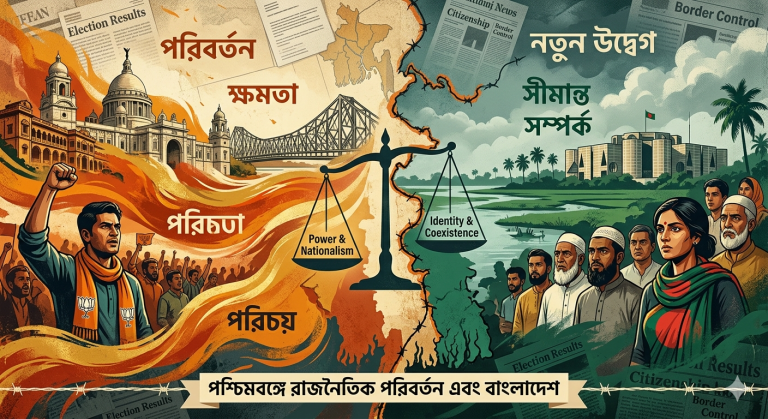
The Battle of Narratives: Media, Power, and the Story Told by the Winner
Bangladesh’s 13th National Election
The Battle of Narratives: Media, Power, and the Story Told by the Winner
By Abeer Uz Zaman
Politics is not shaped by strength alone. It is also shaped by strategy, perception, psychological maneuvering, and the power to define reality in the minds of people. In moments of national crisis or political uncertainty, this truth becomes even more visible. Elections are not fought only through votes, rallies, organization, or street strength. They are also fought through language, framing, emotion, rumor, symbolism, and narrative control.
There is a biblical line often cited in discussions of strategy and power: “By way of deception thou shalt do war” (Proverbs 24:6). This verse is not generally understood as a moral endorsement of injustice. Rather, it can be read as a metaphor for the supremacy of wisdom, planning, and strategic intelligence over brute force. In political life, that distinction matters. Power is not always secured by the strongest actor. Very often, it is secured by the actor who best understands timing, perception, communication, and the management of public belief.
When the succession to a throne is contested between two equally matched princes, the crown does not necessarily go to the physically stronger contender. It goes to the one who masters strategy, psychological maneuvering, and the art of perception. The same logic applies to modern politics. Political actors do not compete only to gain institutional power. They also compete to define what events mean, who appears legitimate, who appears victorious, and what story the public will ultimately remember.
This is why narrative matters so much. Those who can craft the narrative—whether through truth, selective emphasis, or distortion—often gain a decisive advantage. A narrative does not merely describe events; it organizes them into a structure that people can emotionally and politically understand. It turns confusion into meaning. It transforms scattered developments into a story of victory, betrayal, stability, resistance, or inevitability. And once such a story gains public traction, it becomes difficult to dislodge.
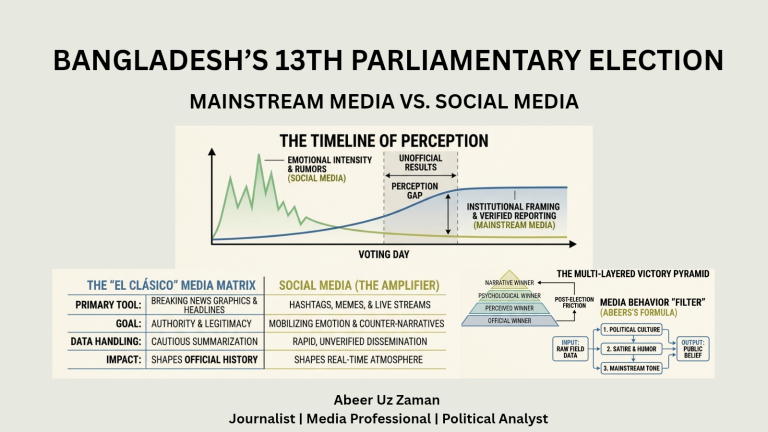
In the context of Bangladesh’s national election, this logic is particularly relevant. At critical moments, elections are not shaped only by the visible contest between parties. They are also shaped by how events are framed by media institutions, how they are amplified on social media, how supporters interpret them, and how political actors try to manage expectation, momentum, and legitimacy. Media can create frames. Social media can intensify and multiply those frames. But the final dominance of a narrative often depends on the side that ultimately secures or retains power.
This does not mean media and social media are unimportant. On the contrary, they are central. Mainstream media can create the first authoritative frame through headlines, televised language, expert selection, and visual emphasis. Social media, meanwhile, can accelerate emotional circulation, intensify partisanship, and create the impression of overwhelming momentum even before outcomes are fully settled. One can shape legitimacy through formality; the other can shape atmosphere through virality. Together, they create a highly unstable information environment in which perception itself becomes a battleground.
Yet there is a deeper truth beneath both media and social media. In the end, the side that emerges as the effective ruler often gains the strongest claim over the final story. The winner does not merely hold office; the winner gains the power to stabilize memory, define meaning, and normalize one interpretation of events above others. This is why, in political history, the story told by the victor so often becomes the dominant version of reality. It is repeated through institutions, defended through power, and gradually accepted as the final frame through which events are remembered.
This is not to say that truth disappears completely or that falsehood always wins. Rather, it is to recognize that political outcomes shape narrative authority. Where there is uncertainty, competing interpretations flourish. But once power is consolidated, one narrative begins to rise above the rest. It is no longer simply one version among many. It becomes the version that institutions can repeat, supporters can defend, and history can absorb.
That is why narrative warfare matters. In politics, the struggle is never only over territory, office, or visible strength. It is also over meaning. Who acted first? Who looked stronger? Who appeared legitimate? Who controlled public emotion? Who framed the turning point? Who made their version of reality feel most believable? These are not secondary questions. They are central questions of political victory.
In the case of Bangladesh’s national election, one lesson stands out clearly: in the battle of narratives, media may frame and social media may amplify, but in the end, the story told by the winner usually prevails. Ultimately, the ruler who secures power becomes the most powerful storyteller.
This is why political communication should never be dismissed as mere commentary. It is part of the struggle itself. It shapes mood, expectation, fear, hope, and legitimacy. And when the political atmosphere becomes tense, dramatic, and uncertain, narrative often matters as much as visible strength.
All’s well that ends well—but in politics, how it ends often determines how it will be told.
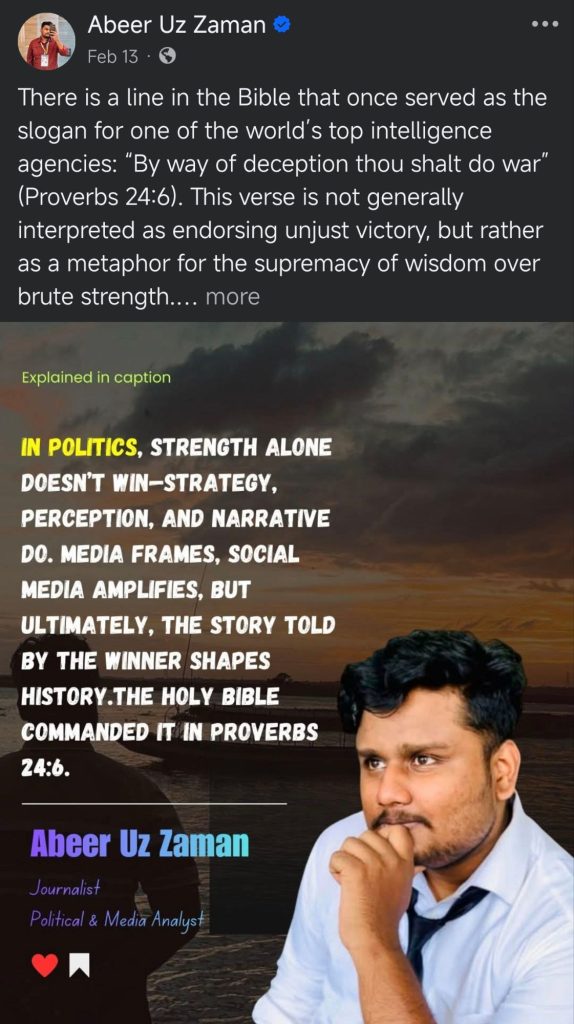
Original Facebook post(click)
Note: This reflection was written during a tense and highly charged moment surrounding Bangladesh’s national election, when dramatic expectations of a last-minute BNP victory and boycott-oriented positioning by opposition-aligned forces created an atmosphere of uncertainty, excitement, and narrative conflict.