Before the Final Count: the Battle for Victory Narratives
A field-informed reflection on media framing, social media amplification, and the politics of perception before the final result of Bangladesh’s 13th National Parliament Election
Note:
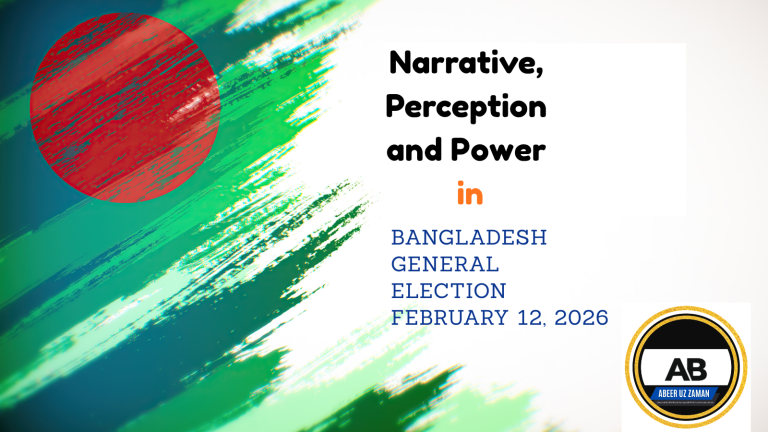
This is an unofficial analytical reflection written from my perspective as a media professional and political analyst. For legal and ethical reasons, I have intentionally avoided naming any political party or candidate directly. The purpose of this piece is not to make an official claim, but to reflect on how media framing, social media amplification, and political perception interacted before final results were formally declared in Bangladesh’s 13th Parliamentary Election.
On the day of the election, my role as a Local Producer for Reuters saw me engaged in a unique experience, as I witnessed two simultaneous contests unfolding right before my eyes. The first of these contests was tangible and easily observable: I was surrounded by polling stations bustling with activity, the public moving in and out, the various developments on the ground, and the drawn-out administrative processes that gradually propelled us towards certainty concerning the results. Each aspect contributed to a real-time narrative that was unfolding physically in my vicinity.
Yet, concurrently, there was another contest taking place that was far less formal but equally significant. This second race was waged across our television screens, social media platforms, and news headlines—a flurry of reactions, declarations, and swiftly evolving narratives online. The sharp contrast between these two realms left a lasting impression on me, reinforcing a belief I have long held: modern elections are not merely fought through the act of casting ballots; rather, they are equally contested through the lens of public perception.
Even before the votes have been fully counted, the endeavor to establish who seems to be winning begins in earnest. The atmosphere of anticipation and speculation often looms large.
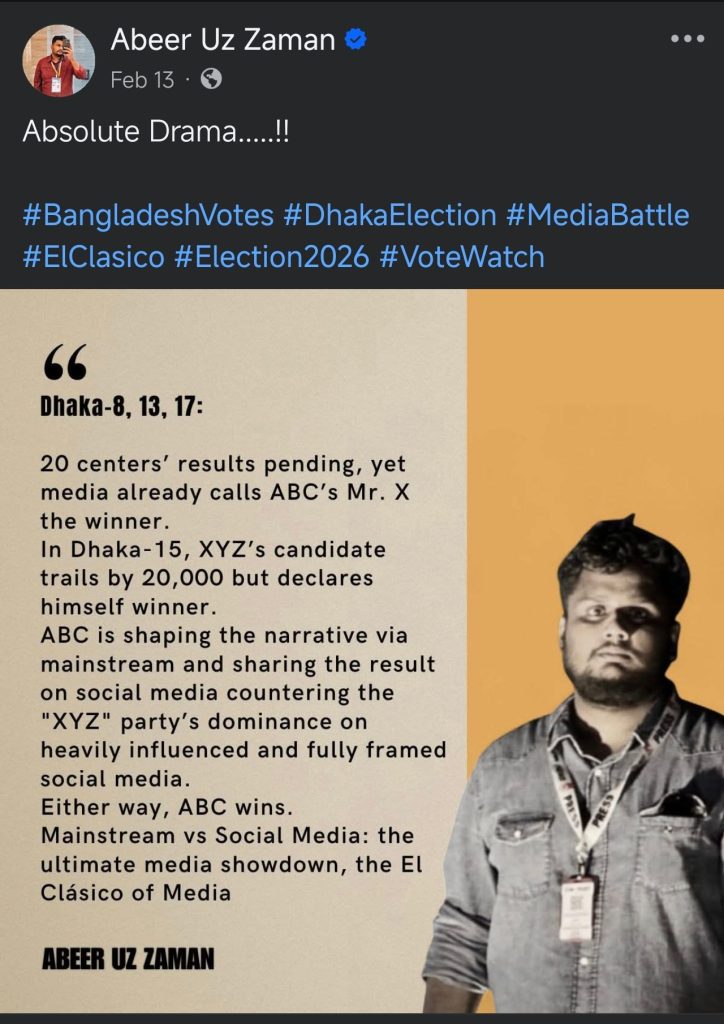
Read the original Facebook post
The Narrative Begins to Form Early On
One of the more striking characteristics of contemporary elections is that the concept of “victory” often begins to crystallize in the minds of the public well before it is formally confirmed through the official processes. Although certain polling places may still be awaiting results and some tallies remain inconclusive, a public impression begins to materialize despite the uncertainty that surrounds the situation. Terms and phrases emerge that suggest a likely winner, while another side works actively to push back against this emerging narrative. Confidence is ardently projected, doubts are magnified, claims of momentum are asserted, and a sense of legitimacy is actively cultivated.
At this juncture, what we are witnessing transcends mere figures; it evolves into a contest that encompasses communication, psychology, and symbolism.
Observations From the Field and the Screens
My experience on the ground, combined with thorough monitoring of both mainstream media outlets and social media activity on election day, revealed a clear pattern: the race to mold the interpretation of the results tends to commence even before the completion of the results themselves. Occasionally, one side is portrayed as if victory is already within their grasp, even as the formal counting process remains incomplete. Meanwhile, another faction may be perceived as lagging behind in the race but nonetheless projects a sense of certainty—not merely as an optimistic outlook, but as a tactical effort to solidify its standing in the ongoing battle for public perception.
This phenomenon illustrates how elections morph from mere numerical contests into vigorous struggles over belief systems.
Who appears to be the frontrunner early on?
Who exudes more assurance?
Whose message gains traction most rapidly?
Whose version of events becomes commonplace?
Which supporters remain spirited and engaged?
The answers to these questions hold significant weight, as the realm of politics operates not only through formal announcements but also through the broader landscape of public perception.
Mainstream Media and Its Framing Power
Mainstream media continues to wield considerable influence over how events are interpreted and understood by the public. A single headline, an urgent news update, or even the tone used in a report can nudge audiences towards forming particular conclusions before they have a complete grasp of the situation. The crux of the matter lies not merely in whether facts are being accurately reported, but rather in how those incomplete facts are framed.
A nascent trend may be misconstrued as a definitive outcome. A cautiously delivered update can be interpreted as a conclusion. A developing lead might be internalized as a legitimate victory. This underscores the potency of framing.
Media doesn’t just relay information; it bestows meaning, infuses direction, organizes the sequence of events, and imparts emotional resonance to what is being observed. During elections, this influence is heightened and becomes a particularly sensitive matter.
Social Media as both Amplifier and Counter-Force
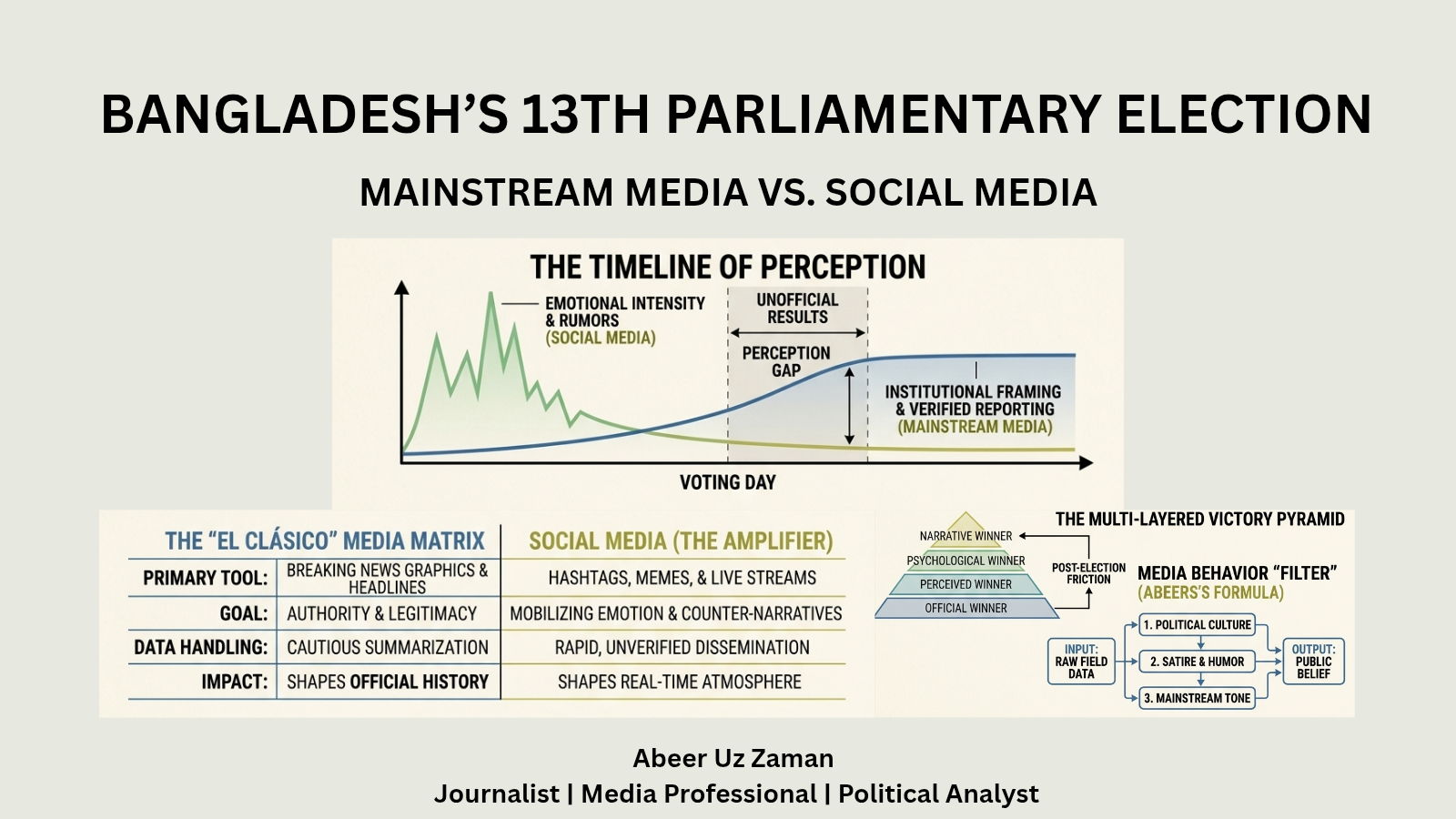
While mainstream media frames narratives, social media serves as an amplifier. It also contests narratives, resists particular interpretations, exaggerates facts, and significantly reconfigures the political landscape. The speed of social media, paired with its ability to curate atmosphere, is what makes it politically consequential. It can swiftly bolster a prevailing narrative while simultaneously spawning counter-narratives—suggesting that the counting process is far from complete, that the framing is hasty, that any momentum is overstated, or that the “real story” has yet to unfold.
In this regard, social media is no longer just a reactive platform; it stands as an active battleground for political dialogue. Unlike traditional media, it thrives on cycles of repetition, emotional responses, symbolism, and collective energy. As a result, it possesses substantial power to shape public perception in a climate where institutional voices have not yet fully articulated their conclusions.
The Importance of the Narrative
While legally, it is the official result that carries weight, and democratically, that must be the standard, politically, different layers of “victory” frequently emerge prior to the formal declaration. There’s the official victor, the perceived winner, the psychological frontrunner, and the narrative champion. These distinctions do not always align perfectly.
The official winner is determined by established processes. The perceived winner is shaped by mass sentiment. The psychological winner is the side that believes it is gaining an advantage. The narrative victor is the one whose version of events resonates sooner, spreads more widely, and feels more plausible in the minds of everyday individuals.
Once this occurs, public memory often begins to crystallize before the official documentation is finalized.
Choosing Not to Name Specific Parties
In writing this piece, I have deliberately refrained from mentioning any political party or candidate. This decision stems from both practical and principled considerations. From a practical standpoint, interpretations made during the election period can easily spiral into unnecessary legal or partisan disputes. Principally, however, my objective here is not to target a specific individual or faction, but rather to scrutinize a broader pattern: how political meanings are shaped and articulated before any political conclusion can be firmly established.
Thus, my focus remains on the process itself rather than casting accusations towards any particular actors or factions.
A Personal Reflection on My Experiences
My work on election day for Reuters, coupled with my careful observation of both the physical landscape and the media and digital realms, has solidified a realization I’ve gleaned from my experiences in journalism and political analysis in Bangladesh: raw events do not enter the public sphere unfiltered. They are shaped by various factors—tone, timing, repetition, framing, and emotional interpretations.
This understanding is why contemporary political literacy demands more than just passively consuming results; it requires an awareness of how results are narrated well before they reach any point of finality. This awareness is especially paramount in a time when many citizens engage with politics primarily through quick headlines, live updates, social media cards, hashtags, clips, and other emotionally charged digital representations. In this environment, perception becomes a fundamental element of the political struggle itself, rather than simply an outcome of it.
A Dynamic Tension: Mainstream Media vs. Social Media
If I were to encapsulate the current landscape, I would express it in a single, potent statement: mainstream media and social media epitomize the central rivalry in today’s political communication.
One outlet frames narratives.
The other amplifies them.
One establishes authority.
The other shapes emotional responses.
And both, in their respective ways, begin to steer how the public interprets events before the final tallies are in.
This interplay is precisely why elections today are not merely contests of numbers; they are also essential battles over meaning itself.
Concluding Thoughts
The significance of election day transcends the routine activities occurring within polling places or counting centers. It extends into the realm of public perception, affecting how citizens think and feel—on their television screens, through headline narratives, via social media timelines, and across the rapidly shifting emotional landscape that dwells between uncertainty and resolution. This is why some of the most pivotal struggles manifest even before the final results are declared.
Not all victories reveal themselves as official from the outset.
Some victories emerge as impressions.
Others take form as headlines.
Still others present as deep confidence, repeated assertions, or compelling stories told with enough urgency and fervor to feel legitimate even before the ultimate truth is confirmed.
This reflection serves as an informal exploration of that intricate phenomenon—recognizing that in the realm of modern elections, while ballots may ultimately determine who wields power, it is often the narratives that shape how that power is perceived long before the ballots are fully counted.