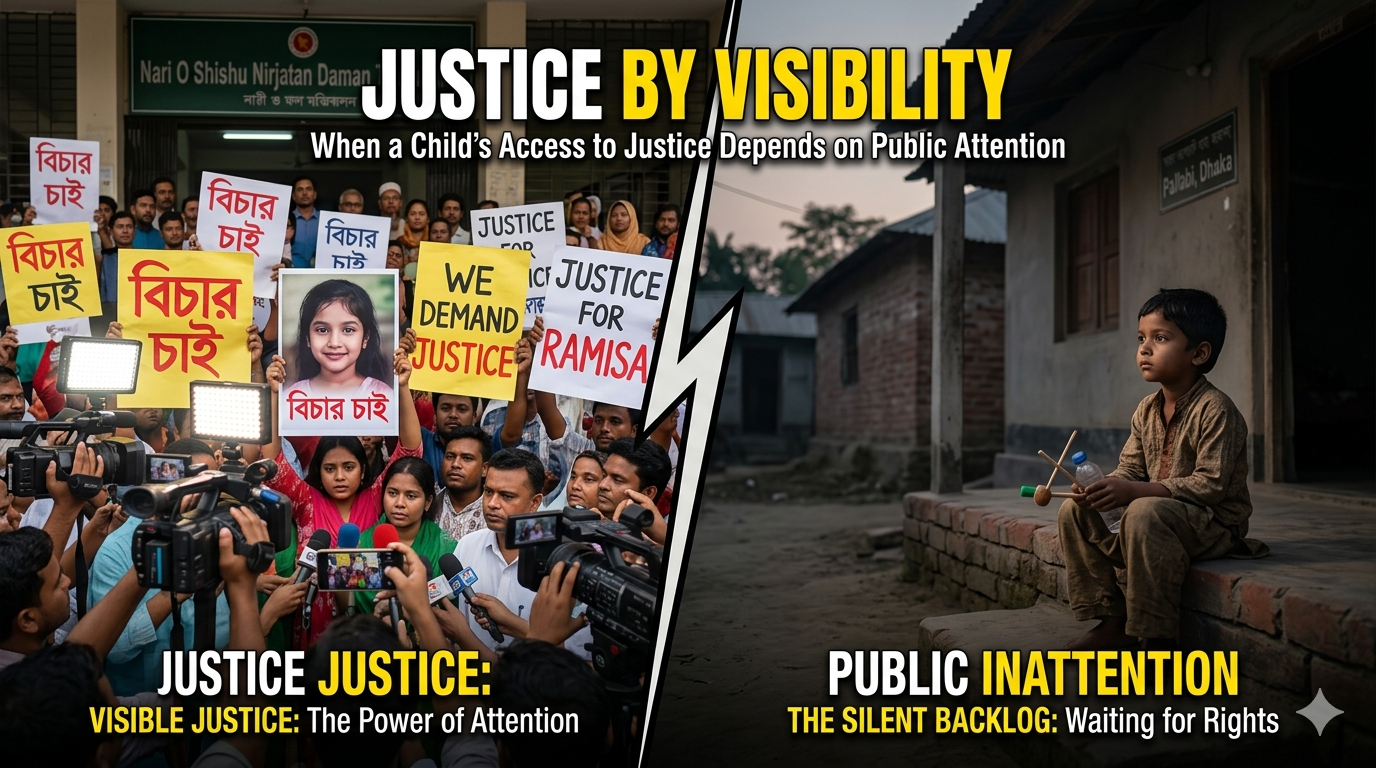
JUSTICE BY VISIBILITY
When a Child’s Access to Justice Depends on Public Attention
Opinion / Op-Ed
A society reveals its deepest values not when it responds to the tragedies everyone can see, but when it responds to those most people never notice.
In June 2026, Bangladesh witnessed one of the fastest criminal verdicts in recent memory.
Just nineteen days after eight-year-old Ramisa Akter was brutally raped and murdered in Dhaka’s Pallabi area, a tribunal delivered its verdict and sentenced the accused to death.
For many citizens, the speed of the proceedings offered a rare moment of confidence in institutions that are often criticised for delay.
The verdict demonstrated something important.
It showed that when urgency exists, the state possesses the capacity to mobilise investigators, prosecutors, courts, and administrative resources with remarkable speed.
Yet the case also raises a question that extends far beyond a single courtroom.
If Bangladesh can move this quickly for one child, why can it not do so for thousands of others?
This is not an argument against justice for Ramisa Akter.
She deserved justice.
Her family deserved justice.
The public demand for accountability was legitimate and understandable.
The real question is whether the same urgency is available to every child whose rights have been violated.
That question matters because justice is not measured only by how a state responds to the most visible crimes.
It is measured by how consistently it responds to all victims, including those whose stories never become national headlines.
The Difference Between Capacity and Will
For decades, Bangladesh has struggled with significant judicial backlogs involving crimes against women and children.
Human-rights organisations, legal observers, and court statistics have repeatedly highlighted delays in investigations, witness examinations, forensic procedures, and tribunal proceedings.
For many families, the pursuit of justice becomes a long and exhausting process.
Years may pass between the filing of a case and the delivery of a verdict.
Some victims never see justice completed at all.
Cases can stall because of procedural delays, repeated adjournments, shortages of judicial resources, witness intimidation, or administrative inefficiencies.
The consequences are profound.
When justice takes too long, public confidence weakens.
Victims lose faith in institutions.
Evidence becomes harder to verify.
Witnesses become difficult to locate.
The possibility of accountability gradually diminishes.
Against this backdrop, the speed of the Ramisa case revealed something significant.
It demonstrated that Bangladesh’s challenge is not solely a lack of institutional capacity.
The state has shown that it can move quickly when sufficient attention, resources, and political focus converge around a case.
The concern is whether that urgency is distributed equally.
When national media, public demonstrations, social-media campaigns, and senior political attention converge around a tragedy, institutions often respond with exceptional speed.
When those factors are absent, many families experience a very different reality.
This creates a dangerous perception.
Citizens begin to believe that justice depends not only on law, evidence, and due process, but also on visibility.
And in any society governed by the rule of law, that perception should be deeply troubling.
The principle of equality before the law requires more than equal legal rights on paper.
It requires equal seriousness in practice.
A system that functions efficiently only when public attention is intense risks creating two categories of victims: those whose suffering becomes a national priority and those whose suffering remains largely invisible.
The Children Who Never Become Headlines
Every year, children across Bangladesh experience violence, abuse, exploitation, trafficking, forced marriage, sexual assault, and murder.
Most of these cases never dominate the national conversation.
Most do not generate days of television coverage.
Most do not trigger nationwide protests.
Most do not receive public statements from senior political leaders.
Yet the rights of these children are identical to those of the most publicised victims.
Their lives possess equal value.
Their suffering carries equal moral weight.
Their families deserve equal protection.
This principle is fundamental to any credible justice system.
The worth of a child’s life cannot be determined by media attention.
The seriousness of a crime cannot depend on whether a hashtag trends online.
And access to justice should never depend on whether cameras arrive at a crime scene.
A justice system is ultimately judged not by how it treats the cases everyone remembers.
It is judged by how it treats the cases everyone forgets.
The true test of equality before the law lies in the state’s willingness to protect the invisible with the same determination it protects the visible.
That is where the conversation must begin.
Because the challenge facing Bangladesh is not simply about one case.
It is about whether institutions can provide consistent protection to all children, regardless of publicity, geography, social status, or political significance.
Beyond Individual Crimes
The discussion becomes even more complicated when child suffering arises not from a single criminal act but from broader institutional failures.
When a child is murdered, responsibility appears relatively clear.
There is a victim.
There is a suspect.
There is an investigation.
There is a courtroom.
But systemic failures rarely present such straightforward pathways to accountability.
Public-health crises, administrative breakdowns, regulatory failures, and governance shortcomings often involve multiple institutions and complex chains of responsibility.
In such circumstances, identifying accountability becomes more difficult.
Yet difficulty does not eliminate responsibility.
If significant numbers of children suffer harm during preventable crises, democratic institutions have an obligation to examine what happened, identify failures, and ensure that lessons are learned.
This is not about assigning blame before evidence is gathered.
It is about recognising that accountability begins with transparency.
Independent inquiries exist for this reason.
They provide opportunities to establish facts, identify weaknesses, recommend reforms, and restore public trust.
Without investigation, important questions remain unanswered.
Without transparency, citizens lose confidence in institutions.
And without accountability, preventable failures risk becoming recurring failures.
The principle should be consistent.
Whether harm results from an individual act of violence or a broader institutional breakdown, the response should involve scrutiny, transparency, and a commitment to learning from mistakes.
Children deserve nothing less.
What the Constitution Requires
The debate over equal access to justice is not simply emotional.
It is constitutional.
At its core, the Constitution of Bangladesh is built upon the principle that all citizens are entitled to equal protection under the law. Equality before the law is not merely a legal slogan. It is a foundational promise that public institutions will operate according to consistent standards rather than selective priorities.
This promise becomes difficult to uphold when similar cases produce dramatically different experiences for victims and their families.
When one case receives extraordinary institutional attention while thousands of others remain trapped in years of delay, questions inevitably arise about fairness, consistency, and equal treatment.
The issue is not whether high-profile cases deserve urgent action.
They do.
The issue is whether less visible victims deserve any less.
A constitutional democracy cannot function on exceptional responses alone.
Its legitimacy depends upon ordinary citizens believing that institutions will protect their rights regardless of social status, political influence, or public visibility.
The Constitution also places obligations upon the state that extend beyond criminal prosecution.
The right to life is not limited to protecting citizens from violence.
It also requires public institutions to create conditions in which life can be safeguarded through effective governance, healthcare systems, child-protection mechanisms, and public accountability.
A child’s rights do not begin when a tragedy becomes newsworthy.
They exist long before public attention arrives.
The responsibility to protect those rights must therefore be continuous rather than reactive.
International Obligations
The principles at stake are not only domestic.
They are also international.
Bangladesh is a State Party to the United Nations Convention on the Rights of the Child (CRC), one of the most widely accepted human-rights treaties in the world.
The Convention establishes a simple but powerful principle: every child matters equally.
Under Article 2, children are entitled to protection without discrimination.
Under Article 6, states must protect every child’s right to life, survival, and development.
Article 19 requires protection from violence, abuse, neglect, and exploitation.
Article 24 recognises every child’s right to the highest attainable standard of health.
These obligations are universal.
They do not distinguish between children who appear on national television and children whose stories remain known only to their families.
They do not distinguish between urban and rural communities.
They do not distinguish between children from wealthy families and children from marginalised backgrounds.
The obligations remain the same.
The responsibilities remain the same.
The rights remain the same.
Bangladesh is also a party to the International Covenant on Civil and Political Rights (ICCPR), which emphasises equal protection before the law and access to effective remedies when rights are violated.
Likewise, the Universal Declaration of Human Rights affirms that every person is entitled to equal protection without discrimination.
Taken together, these commitments establish an important principle.
A rights-based system cannot allow visibility to determine value.
A child’s life does not become more important because the public notices.
The state’s duty exists regardless of whether attention follows.
Justice as a Moral Responsibility
Legal obligations alone cannot sustain a just society.
Every legal system ultimately rests upon deeper moral foundations.
For Bangladesh, a country whose social consciousness has been shaped by diverse cultural, ethical, and religious traditions, justice is not simply a procedural matter.
It is a moral responsibility.
Across different traditions, one principle appears repeatedly:
The treatment of the vulnerable reveals the character of a society.
Children occupy a unique position within this framework.
They possess neither political influence nor institutional power.
They cannot lobby policymakers.
They cannot direct public attention.
They cannot defend their interests in the way adults can.
Their wellbeing depends almost entirely upon the integrity of families, communities, and institutions.
This reality creates a special responsibility for those who hold authority.
Public officials, judges, policymakers, law-enforcement agencies, healthcare administrators, educators, and community leaders all exercise forms of power that affect children’s lives.
The ethical question is therefore not merely whether wrongdoing is punished.
It is whether those entrusted with responsibility act with sufficient diligence to protect those who cannot protect themselves.
A society committed to justice must ultimately be judged by how it treats its most vulnerable members.
Not when public pressure demands action.
But consistently, even when no one is watching.
The Danger of Selective Urgency
One of the most significant risks facing any justice system is the emergence of selective urgency.
Selective urgency occurs when institutions respond rapidly to certain cases while moving slowly on others that involve similar harms.
The consequences extend far beyond individual victims.
First, selective urgency weakens public confidence.
Citizens begin to suspect that outcomes depend less on consistent legal standards and more on visibility, influence, or political attention.
Second, it encourages the politicisation of suffering.
Victims become symbols in broader public debates rather than individuals seeking justice.
Cases are evaluated according to their public impact rather than their intrinsic seriousness.
Third, selective urgency places pressure on institutions to operate reactively rather than systematically.
Resources become concentrated on exceptional cases while structural problems remain unresolved.
This may create impressive short-term outcomes, but it does little to address the underlying causes of delay and inequality.
Most importantly, selective urgency risks creating a hierarchy of victimhood.
Some tragedies become national priorities.
Others disappear from public memory.
Such a hierarchy is fundamentally incompatible with the principle of equal justice.
A child’s rights should never be determined by public attention.
Justice should not become more accessible because cameras arrive.
And accountability should not become more likely because a case generates political pressure.
The strength of a legal system lies in its consistency.
The strongest institutions are not those that occasionally perform exceptionally.
They are those that perform fairly, predictably, and transparently for everyone.
Public Trust and Democratic Legitimacy
Trust is one of the most valuable assets any institution possesses.
Courts depend upon it.
Law-enforcement agencies depend upon it.
Governments depend upon it.
Without trust, even the most sophisticated legal framework struggles to function effectively.
Public trust is built when citizens believe that institutions will apply rules consistently and fairly.
It is strengthened when accountability mechanisms operate transparently.
It grows when victims see that their concerns are taken seriously regardless of who they are.
Conversely, trust deteriorates when people perceive that some lives receive greater protection than others.
Even when institutions act with good intentions, perceptions of unequal treatment can produce lasting damage.
This matters because democratic legitimacy depends not only on elections or legal procedures.
It depends on whether citizens believe that public institutions serve the entire population rather than a visible few.
For many families, justice is not an abstract concept.
It is personal.
It is measured by whether investigations are conducted properly.
Whether hearings occur on time.
Whether evidence is collected effectively.
Whether officials take their concerns seriously.
And whether institutions remain engaged even after public attention fades.
When those expectations are met consistently, trust grows.
When they are met only occasionally, confidence weakens.
The long-term challenge for Bangladesh is therefore not simply to demonstrate that rapid justice is possible.
It is to demonstrate that equal justice is possible.
That challenge is far more important.
And ultimately, far more consequential for the future of democratic governance.
What Reform Should Look Like
If the objective is equal justice, the solution is not to reduce urgency in high-profile cases.
The solution is to extend that urgency to all cases involving children.
The lesson of the Ramisa Akter case should not be that rapid justice is exceptional.
The lesson should be that rapid, professional, and accountable responses are possible when institutions are properly mobilised.
The challenge now is transforming isolated examples of institutional effectiveness into consistent standards across the justice system.
Meaningful reform does not require reinventing fundamental principles.
Most of the necessary principles already exist.
The challenge lies in implementation.
A child-protection system cannot depend on public outrage as its primary mechanism for action.
It must be capable of functioning effectively even when there are no headlines, no demonstrations, and no national debate.
The goal should be to create institutions that respond to every child with the same seriousness that society reserves for the most visible tragedies.
Building a National Child Justice Framework
A comprehensive approach requires viewing child protection as more than a criminal-justice issue.
Children interact with multiple systems simultaneously.
They rely on healthcare services, educational institutions, social-welfare mechanisms, law-enforcement agencies, local government structures, and courts.
Weakness in any one of these systems can place children at risk.
For this reason, reform should focus on coordination rather than isolated interventions.
Investigations must be efficient.
Courts must be adequately resourced.
Child-protection agencies must possess sufficient capacity.
Public-health institutions must be capable of responding rapidly to emerging threats.
Data systems must be transparent enough to identify problems before they become crises.
Most importantly, accountability mechanisms must function consistently.
A society cannot effectively protect children if failures remain hidden or if institutions are reluctant to examine their own shortcomings.
Transparency is not a threat to governance.
It is one of the foundations of effective governance.
Policy Priorities
Several reforms deserve serious consideration.
1. Independent Inquiries into Major Child-Protection Failures
Whenever large-scale failures affect children—whether involving violence, abuse, institutional negligence, or public-health concerns—independent inquiries should be established to determine facts and recommend corrective action.
The purpose of such inquiries should not be political blame.
Their purpose should be accountability, transparency, and institutional learning.
2. Strengthening Specialised Tribunals
Cases involving crimes against women and children frequently face significant backlogs.
Additional judicial resources, expanded tribunal capacity, improved case-management systems, and enhanced support services for victims could help reduce delays.
Timely justice should be regarded as a core element of justice itself.
3. National Standards for Child-Related Cases
Bangladesh should consider developing clear national benchmarks regarding investigation timelines, evidence collection, witness protection, and case-processing standards in matters involving children.
Consistency helps reduce inequality.
It also improves public confidence.
4. Transparent Public Reporting
Institutions should regularly publish data regarding investigations, prosecutions, convictions, case backlogs, and processing times.
Transparency allows citizens, researchers, journalists, and policymakers to evaluate performance objectively.
What is measured can be improved.
What remains hidden is often neglected.
5. Independent Child-Rights Oversight
An independent mechanism dedicated to monitoring children’s rights could help identify systemic weaknesses before they become national crises.
Such oversight structures exist in various forms around the world and often play an important role in promoting accountability.
6. Strengthening Public Health Accountability
Protecting children requires more than criminal-law enforcement.
Healthcare systems, immunisation programmes, disease surveillance mechanisms, emergency preparedness frameworks, and public-health decision-making processes all play critical roles.
When failures occur, transparent evaluation should follow.
Learning from mistakes is essential to preventing future harm.
The Larger Question
Ultimately, this discussion is not about a single verdict.
Nor is it about a single institution.
It is about the standards by which a society chooses to value human life.
Every nation faces moments that reveal both its strengths and its weaknesses.
The rapid response in the Ramisa Akter case demonstrated that Bangladesh possesses the capacity to act decisively when public attention is focused.
That capacity should be recognised.
But recognition alone is not enough.
The more important question is whether that same commitment can be institutionalised.
Can urgency become routine rather than exceptional?
Can accountability become systematic rather than selective?
Can visibility cease to be a prerequisite for action?
These questions matter because public trust is built not through isolated successes but through consistent performance.
Citizens do not evaluate institutions solely by their best moments.
They evaluate them by everyday experiences.
By whether rules are applied fairly.
By whether rights are protected consistently.
And by whether vulnerable people receive equal treatment regardless of circumstance.
Conclusion: The Child We Do Not See
Ramisa Akter deserved justice.
The nation was right to demand accountability.
The speed of the response demonstrated what institutions can achieve when sufficient urgency exists.
But the lesson of her case should not end with a single verdict.
It should begin a broader conversation.
A conversation about every child whose case never becomes a headline.
Every family that waits years for answers.
Every victim whose suffering disappears into statistics.
Every tragedy that receives less attention because it unfolds far from the public spotlight.
Justice cannot depend on visibility.
Rights cannot depend on publicity.
And accountability cannot depend on political convenience.
The true test of a nation is not how quickly it responds when cameras are present.
It is how consistently it protects those whose suffering unfolds beyond public attention.
A society committed to equality before the law must ensure that justice is not reserved for the visible.
It must belong equally to those whom history, politics, geography, and public attention too often overlook.
Because the measure of a society is not how it treats the tragedy everyone sees.
The measure of a society is how it responds to the tragedy that almost no one sees at all.