When Bengal Turns Saffron: Power, Identity, and the New Anxiety Across the Border
A political shift in West Bengal is not just about one election — it is about identity, narrative, and a changing regional reality for both India and Bangladesh.
Introduction
West Bengal has not just changed its government. It has changed the political psychology of eastern India.
For years, Bengal was seen as a space where language, culture, and a tradition of coexistence could resist aggressive majoritarian politics. Mamata Banerjee became the strongest political face of that resistance.
Her defeat, therefore, is not just the fall of a leader. It is the weakening of a political shield.
But an important question must be asked:
Is Mamata’s defeat the defeat of Bengal?
The answer is not simple.
A Historic Political Shift
The rise of the Bharatiya Janata Party (BJP) in West Bengal did not happen overnight.
- In 2016: BJP had only 3 seats
- In 2021: BJP became the main opposition with 77 seats
- In 2026: BJP reached the stage of forming the government
This is not an accident. It is the result of:
- Strong organisation
- Long-term political planning
- Narrative control
- Weak opposition space
- Voter frustration with the ruling party
This is how political power grows — slowly, then suddenly.
Why Did BJP Win?
The victory cannot be explained by one factor.
1. Anti-Incumbency
After many years in power, voters often become frustrated.
Complaints about corruption, local dominance, and administrative fatigue created space for change.
2. Opposition Collapse
The decline of Left and Congress made BJP the only strong alternative.
Many voters may not fully support BJP ideology, but they saw it as the only force capable of defeating the ruling party.
3. Strong Narrative
BJP changed the political conversation.
Instead of:
- “Protect Bengal from Delhi”
It shifted to:
- “Change Bengal from within”
It combined:
- Nationalism
- Security
- Leadership
- Welfare narrative
4. Identity Politics
Religious identity became more visible in political messaging.
But it is important to understand:
Not every voter voted for ideology alone.
Many voted for change, frustration, or opportunity.
Is Bengali Identity Under Threat?
This is the most sensitive question.
Bengal’s identity is built on:
- Language (Bangla)
- Literature and intellectual history
- Cultural coexistence
- Political awareness
These are deep-rooted foundations.
They cannot disappear after one election.
But they can be reshaped.
Cultural Change vs Political Control
Political power does not always destroy identity.
It often redefines it.
A new narrative may emerge:
- Bengali identity within Hindu identity
- Regional pride within national identity
- Culture within a larger ideological framework
This is not direct replacement.
This is gradual transformation.
Why This Matters for Bangladesh
West Bengal is not just another Indian state.
It is:
- A cultural bridge
- A linguistic connection
- A historical link with Bangladesh
Any political shift there affects Bangladesh directly.
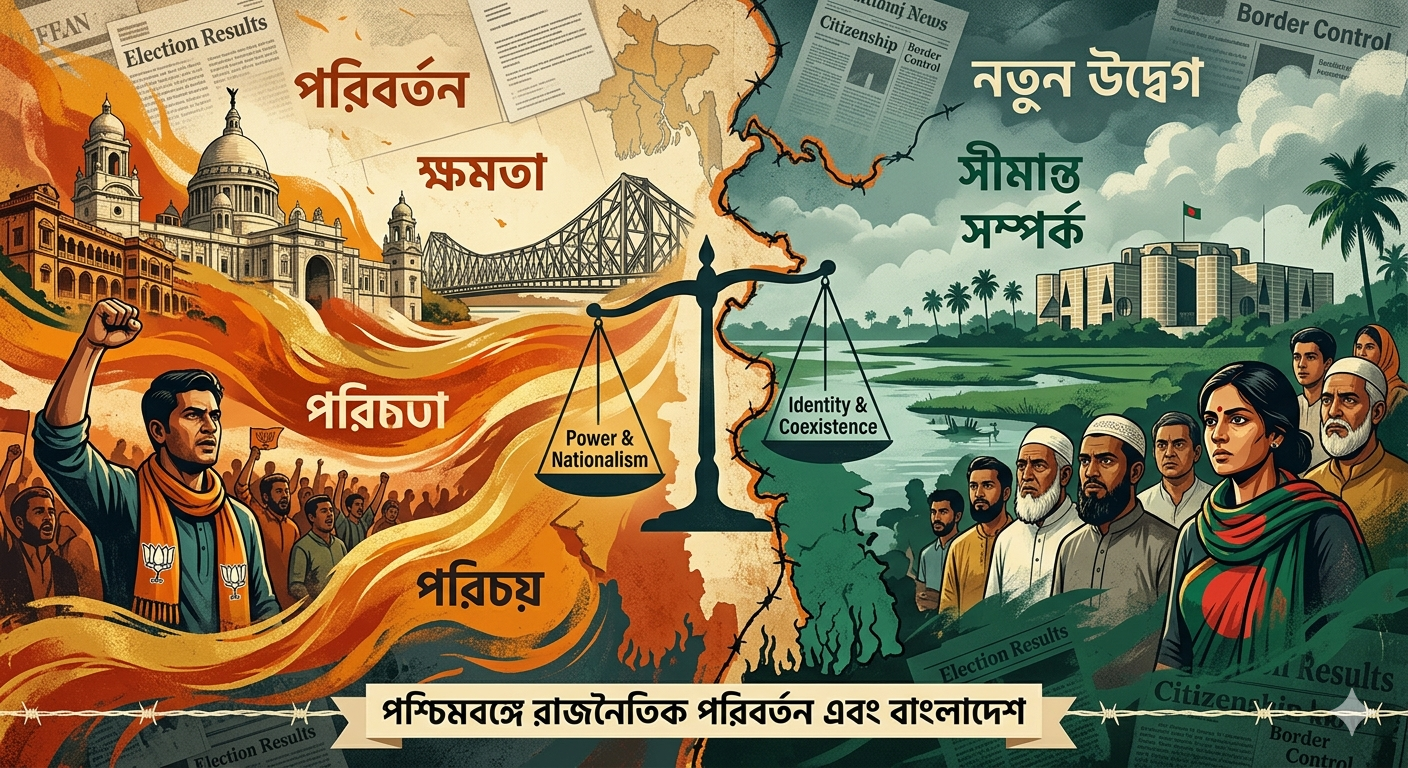
Border Politics and “Infiltration”
One major concern is the growing use of the term:
“Bangladeshi infiltrator”
This language is politically powerful.
But it can also create:
- Suspicion against Bengali-speaking Muslims
- Pressure on border communities
- Tension in diplomatic relations
The Risk of Pushback Politics
In some Indian states, there have already been discussions about:
- Identifying illegal migrants
- Deportation or “pushback”
- Stronger border enforcement
If such policies expand into West Bengal, Bangladesh may face:
- Humanitarian pressure
- Diplomatic challenges
- Border tension
Is Bangladesh Surrounded Politically?
It would be incorrect to say Bangladesh is completely surrounded by BJP governments.
However, it is accurate to say:
The political influence of BJP/NDA in the eastern border region has become much stronger than before.
This changes the security and political environment.
Competing Narratives: Fear vs Reality
Two types of narratives often appear:
- “Civilisational nationalism” (like Akhand Bharat ideas)
- “Religious war imagination” (like Ghazwatul Hind discussions)
These are not the same.
But they can feed fear on both sides.
Responsible analysis must avoid panic and focus on real policy and action.
The Muslim Question in Bengal
For many Bengali Muslims, the previous government represented a level of political protection.
With a new government, concerns may grow around:
- Citizenship verification
- Administrative behaviour
- Social confidence
- Public rhetoric
This is where democratic responsibility becomes critical.
What Happens Next?
The future depends on several factors:
- How BJP governs
- How opposition rebuilds
- How civil society responds
- How identity is negotiated in everyday life
A political victory does not automatically change society.
But it creates the power to shape it.
Conclusion
Mamata’s defeat is not automatically Bengal’s defeat.
But it is the collapse of one political imagination of Bengal.
The deeper question now is:
Can Bengali identity survive within a strong majoritarian political framework without losing its plural character?
For Bangladesh, the message is clear:
Do not panic.
Do not ignore.
Understand the shift.
The region has entered a new phase.
The story is not over.
But the direction has changed.
Documents. Evidence. Accountability.