Tarique Rahman : Captain of a Sinking Ship or the Man at the Center of a Political Labyrinth?
To understand Bangladesh’s present political moment, it is not enough to look only at the transfer of power; one must also look at on whose shoulders the real burden of running the state has fallen after taking power. After BNP’s sweeping victory in February 2026, Tarique Rahman was sworn in as Prime Minister, and it marked a major political turning point after Bangladesh’s recent period of instability. In Reuters’ telling, it was “a significant political shift,” and in various international analyses too, this victory was seen as the return of an elected government after a long interim uncertainty.
It is within this reality that the metaphor of the “captain of a sinking ship” becomes politically meaningful. Because today Tarique Rahman has taken the helm of a state machinery that is simultaneously facing economic pressure, energy risk, weakness in the banking sector, fragility in law and order, mob culture, a crisis of police morale, and an ideologically divided opposition politics. Bangladesh’s finance minister himself recently said that recapitalization of the banking sector and the private sector is necessary; at the same time, the government has also spoken of the need for more than 2 billion dollars in external financing to deal with the shortfall in energy imports. Reuters further reported that the war situation in the Middle East has put Bangladesh under new pressure by raising fuel prices, which has also led to an increase in retail fuel prices.
In this sense, the state standing before Tarique Rahman is not only politically wounded, but administratively wounded as well. Although controlling the law-and-order situation has been seen as one of the priorities of the new government, analysis in the English edition of Prothom Alo has pointed out that illegal arms, extortion, professional criminals, drugs, and the risk of extremism have made the situation difficult. At the same time, the morale of the police force has also been discussed openly; in January, The Hindu reported that Tarique Rahman praised the “demoralised” police for handling a large public gathering—which itself signals that the problem is not only crime, but also cracks in the confidence of the state’s coercive machinery.
At this point, the first question stands before us: is Tarique Rahman merely the one in power, or is he in reality the repair manager of a decaying state reality? My reading is that he is much more the latter now.
Recent Examples of Efforts to Establish Stability
It would be a mistake to see Tarique Rahman only as a symbolic leader. At least some recent steps show that he is trying to put forward a roadmap to “normalise” the state. One of the most visible examples is the “Farmers’ Card” or “Krishok Card” program, which has been announced as an initiative to make subsidies, seeds, fertilizer, machinery, low-interest loans, crop insurance, and digital information services more accessible for farmers. The target announced is to include more than 22,000 farmers at the pilot stage and reach 27.5 million farmers within five years. This type of policy is not only welfare-oriented; it is politically important too, because it is an attempt to pull the state from street-politics toward service-delivery politics.
Likewise, international and regional news sources have reported that the Tarique Rahman government has promised to control inflation, stabilize the market during Ramadan, and re-establish the rule of law. But this is exactly where the big test lies: announcement and implementation are not the same thing. Promises to end mob culture have come repeatedly from the top level of government—the Home Minister, the Information Minister, and even Tarique Rahman himself have in the past called for an end to mob culture. But a recent editorial in The Daily Star says that if violent crowds continue to get away repeatedly despite repeated warnings, then the message sent to the street is the opposite—the state is hesitant, and punishment remains uncertain.
In other words, one part of Tarique Rahman’s stabilisation strategy is to bring the state back to welfare, order, and procedural politics; but its adversary is not only the opposition party, but also an informal coercive culture existing outside the state.
“The Tarique of One-Eleven” vs “The Returned Tarique”
An important political idea within this frame is this: has Tarique Rahman changed? International media have portrayed his return as a journey “from exile to power,” and during the campaign phase he also promised “clean politics.” Both Al Jazeera and Reuters showed that the post-exile Tarique Rahman has presented himself as a leader who is more restrained, more strategic, and more eager than before to seek broad-based legitimacy.
Here, an assessment like “He had a plan” cannot be written entirely as fact; but from observing his political conduct, it can be said that he is at least trying to project a mark of programmatic politics instead of spontaneous populism. Farmers’ cards, efforts at energy financing, defensive engagement around reform discourse, and law-and-order messaging—all of these suggest that he is not merely selling emotion; he is trying to build a state-management narrative.
But the Problem Is: He Is Under Pressure on Multiple Fronts at Once
Tarique Rahman’s greatest political misfortune—or perhaps the ultimate test of his skill—is that he is having to handle several contradictory pressures at the same time.
First, the banning of the Awami League. The restriction that began with an order of the interim government in 2025 was given legal force in April 2026 when Parliament passed the Anti-Terrorism amendment bill. As a result, the Awami League has been pushed not only practically, but legally as well, to the margins. But that does not mean that Awami influence, its networks, or its reactive politics have vanished in a single day. Rather, this banning has created a silenced but angry vacuum in Bangladesh’s politics.
Second, the restructuring of opposition politics. After the election, Jamaat-e-Islami emerged as the principal opposition force, and tensions among BNP, Jamaat, and the National Citizen Party over the July Charter and the question of reform have become visible. Reuters, Al Jazeera, and TBS alike have shown that BNP is under a certain kind of pressure over the reform council, referendum proposals, and the interpretation of the “July Charter.”
Third, mob politics versus constitutional politics. In its 2026 world report, Human Rights Watch noted a rise in mob violence in Bangladesh by political parties, religious hardliners, and other non-state actors. Recent observations in The Daily Star also say that if visible punishment does not come even after repeated attacks, the deterrence capacity of the state declines. That means the Tarique Rahman government is facing not only opposition speech, but the ecology of informal coercion.
Fourth, tagging culture. Although I have not found a recent official document-based measurement of the phrase “tagging culture,” analysis in The Daily Star has shown that for many years a culture has been built in which labels such as “pro-India,” “anti-Islam,” “foreign-backed,” and “anti-Bangladesh” are used to delegitimize opposing voices or criticism. If this culture of labeling now survives in the hands of new actors as well, then it becomes a double problem for Tarique Rahman: on the one hand he wants state stability, but on the other hand the same political culture may begin to close in around him too.
So Should We Call It Quicksand, or Entry into a Chakravyuh?
Your frame here is compelling—quicksand, or chakravyuh? My analysis is this: not quicksand, but chakravyuh is the more accurate metaphor.
A fall into quicksand happens mainly because of an invisible pull. But in the current situation, the pressures surrounding Tarique Rahman are quite visible:
- a fragile economy
- energy uncertainty
- the shadow of an old ruling force that has been banned but not truly finished
- ideological rivals such as Jamaat and the NCP
- mob culture
- the need for psychological reconstruction of the police and administration
- and the limits of state power versus public expectation
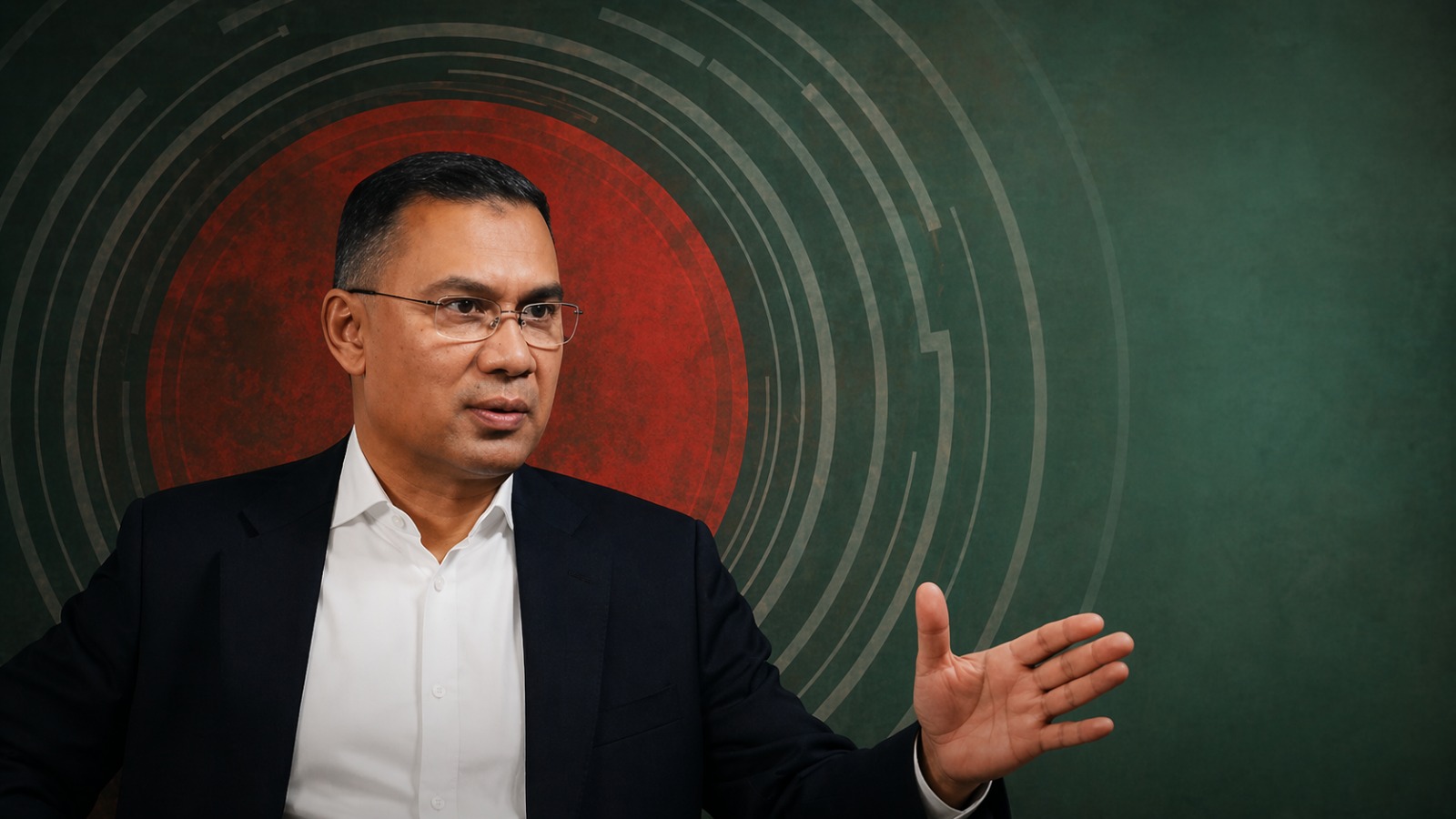
Each of these concentric pressures together is creating not an invincible, but a multi-layered political chakravyuh. It cannot be said entirely that he has entered it “unknowingly,” because coming to power is itself a conscious political objective. But the density of the multi-directional resistance he would face is perhaps now becoming clearest. In this sense, the metaphor of Abhimanyu from the Mahabharata, though emotional, is not entirely unreasonable—yet there is one difference: unlike Abhimanyu, Tarique Rahman is not alone; he has the government, the party, the administration, and the legitimacy of an electoral mandate in his hands. The question is: can he turn all of these into a coherent chain of command?
The Post-Sheikh Hasina Comparison: A Place for Caution
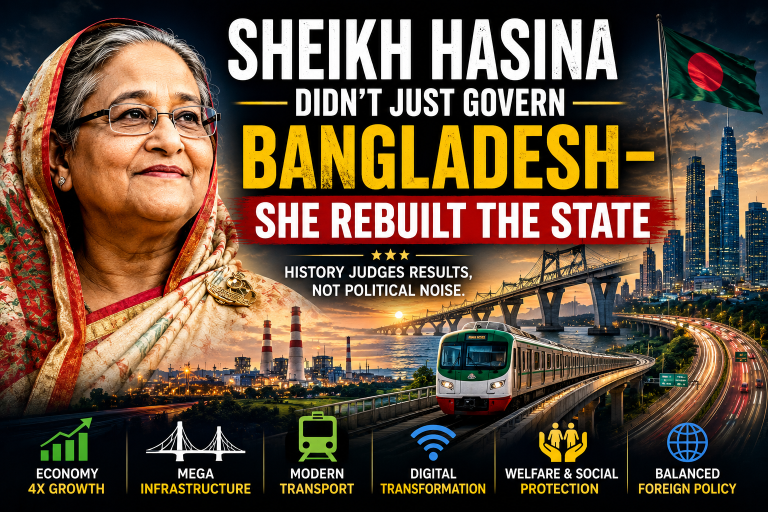
The comparison you wanted to draw—that Sheikh Hasina at the end of her 17-year rule became trapped in a kind of “meticulous design” formation—is politically provocative. But factually it must be said carefully: international reporting on Sheikh Hasina’s fall has pointed to long-term authoritarianism, suppression of the opposition, human rights violations, and the post-2024 mass uprising as the principal reasons. So being “forced into a trap” is not the only explanation; rather, over-centralization of power, the moral decay of the chain of command, and the erosion of public support were also major causes.
The lesson from that comparison for Tarique Rahman is this: excessive personal dependence by the state ultimately weakens the leader himself. If he begins to be seen as a “one-man army,” it may first become charisma, and later liability.
The Opposition, Other Groups, and BNP’s Own Responsibility
Now let us come to the second part—the role of the opposition and of other groups. Recent developments suggest that Jamaat and the NCP have tried to portray BNP as a force that is anti-reform or has moved away from the spirit of July. At the same time, Tarique Rahman has counter-accused some groups of confusing the public through reform narratives. That means the language of opposition is no longer simply “government versus opposition”; rather, there is now a competition over which force is the legitimate heir of the post-2024 public aspiration.
But the analysis will remain incomplete if blame is placed only on the shoulders of the opposition. If, within BNP itself, aggressive behaviour at the local level, a mentality of capture, celebration-driven power practice, or the attitude of “we are now the state” begins to grow, that too will embarrass the government. The biggest signal of that comes from the question of mob culture. Because mob politics is almost never the product only of the opposition camp; over-excited local elements of the ruling side can also, knowingly or unknowingly, feed it. The criticism in The Daily Star in fact points to this broader reality—if the state does not show visible punishment, then street power returns in different colours.
Final Word
In my assessment, Tarique Rahman is now in Bangladesh’s politics more than a person in power—he is the central character of a laboratory. The challenge before him is not simply to run the country; rather, it is to prove whether he can turn an electoral mandate into administrative restraint, reconstruction of law and order, economic stability, and political tolerance.
That he is being pulled and restrained from every side is difficult to deny. The economy is pulling, the mob is pulling, ideological opposition forces are pulling, the shadow of the banned old ruling force is pulling, and the height of public expectation is putting him through a new test every day. But this is where the core question lies: is he merely the captain of a sinking ship, or the commander of a newly built one?
It would be too early to give a final answer at this moment. But one thing can be said: if he can show visible success in these five pillars—welfare delivery, rule of law, police confidence, energy management, and anti-mob enforcement—then it will be possible for him to break through his present chakravyuh. And if he cannot bind the party, the government, and the forces on the street into a single political ethic, then this same formation will gradually consume him. The present state of facts and evidence says at least this much: the war has not yet been won—but nor has it been finally lost.