A Personal Story on Ethics, Fear, Courage, and Why I Chose Journalism
My interest in journalism did not begin with ambition, glamour, or career calculation. It began much earlier, in the moral world I inherited from my family, my surroundings, and my own conscience.
My mother is a head teacher at a government primary school. With pride and unwavering conviction, she has always said, “A teacher’s child can never do wrong.” In her understanding, teaching is not merely a profession; it is a moral responsibility. All my life, I have tried to preserve the trust she placed in morality, conscience, and upright conduct.
Yet over time, I came to feel that while teaching is deeply noble, its ethical reach can sometimes be limited in scale, and its visible impact may take a long time to unfold. I wanted a profession through which morality could act more directly, more courageously, and more publicly.
Because of my father’s government postings, nearly five years of my childhood were spent in Chattogram. Perhaps the geography of that land—its hills, its sea, and the historical memory of Masterda Surya Sen and Pritilata—helped shape me into someone resilient, courageous, and willing to endure hardship. My mother also learned music from a teacher who taught patriotic songs and songs of Bangladesh’s Liberation War. Those sounds, those values, and those memories were part of the environment in which I grew up.
I believe nature gave everything it had to make me who I am.
For a long time, I have believed that the highest profession through which one can practice morality with courage—and through that courage help create the path toward good governance and civil rights—is journalism.
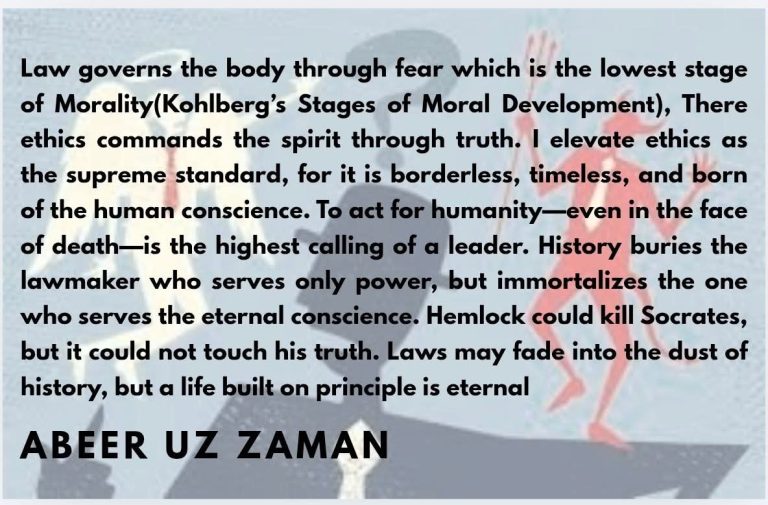
I believe people obey the law to avoid punishment, but people become moral through the philosophy of conscience. That is why, where many law-abiding people may still remain at the lowest stage of Kohlberg’s Moral Development, I have always wanted to place myself at the highest one. To me, journalism is 90 percent an ethical profession and only 10 percent a legal one.
If a false report is published, the law may be broken. But if a true report is deliberately not published, the law may remain untouched—yet a terrible ethical collapse takes place inside the journalist and the media institution. To me, suppressing a true report is a thousand times more dangerous than almost anything else.
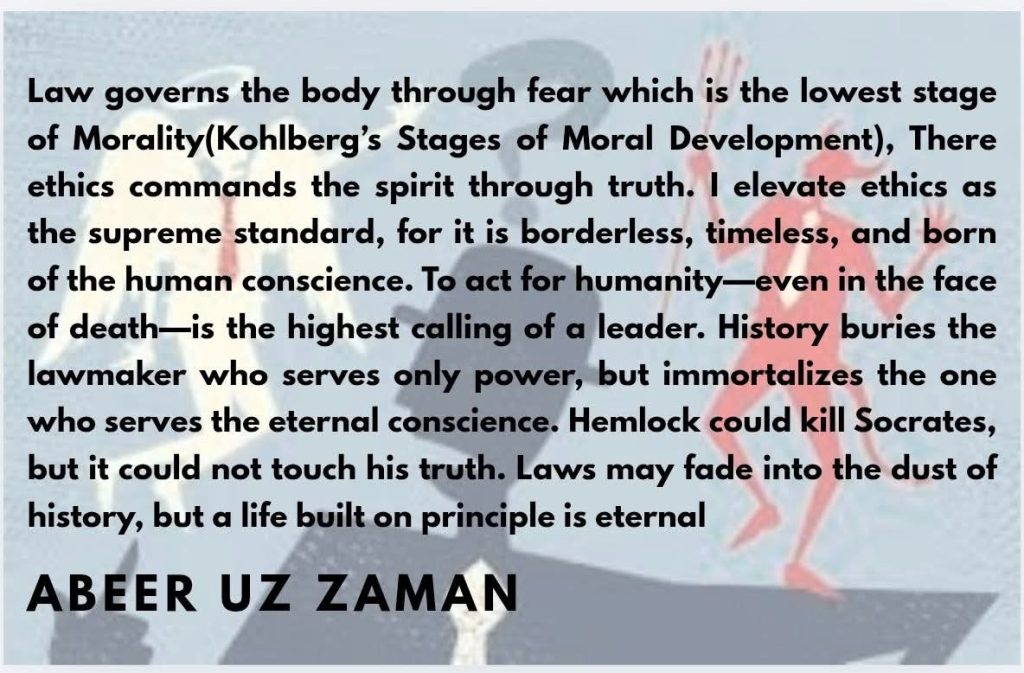
Ethics Beyond Law: Why Humanity Must Remain the Highest Standard
This moral understanding sparked my interest in journalism as a means to resist injustice and confront it. That is how I decided to pursue journalism as my future profession.
I applied to Jagannath University, one of Bangladesh’s most respected public universities, to study for a Bachelor of Social Science (BSS) in Mass Communication and Journalism. Out of more than 1.3 million Higher Secondary Certificate examinees initially screened, only a small number were shortlisted for the entrance examination. I successfully qualified and, through the MCQ and written tests that followed, earned admission to my preferred department.
During my first year, I read The Works of Thomas Jefferson, Volume 5. Jefferson’s views gave me a deeper understanding of journalism’s place in governance and nation-building. His famous preference for “newspapers without government” over “government without newspapers” strengthened my conviction that choosing journalism was not merely a personal decision; it was one of the most meaningful decisions a responsible citizen could make.
In the eighth and final semester of my BSS degree, I completed my internship at The Daily Inqilab. My supervisor was a kind man, and from what I saw and understood, he was also honest.
One day, while sitting at his desk, I saw an investigative field report prepared by a correspondent from Faridpur/Shariatpur. It covered nearly an entire page. Its subject was: “A Market for Banned Mother Hilsa on the Sandbanks of the Padma.” A large red cross had been marked across the report. The editor had forbidden its publication. The explanation was that publishing such a report at that particular moment would hurt public sentiment in the context of the then interim government.
Naturally, my supervisor removed the report.
I argued with him. I said that the work of the media is to publish the truth. If truth harms someone’s interests, then that should be understood as evidence that the person or group is doing something wrong.
He avoided the discussion by saying it was an instruction from above.
That day, I understood something clearly: in this country, house policy is often shaped by corporate ownership and political influence. Within such a structure, it would not be possible for me to practice morality fully through my profession.
To deepen both my academic and practical understanding of media, I am now pursuing a Master of Social Science (MSS) in Journalism, Media, and Communication at Daffodil International University, Dhaka.
At the same time, I began my own online news portal as Editor: Daily Dhaka Gazette. My inspiration was Hicky’s Bengal Gazette—the earliest newspaper in colonial Bengal, a symbol of fearless publication and inconvenient truth.
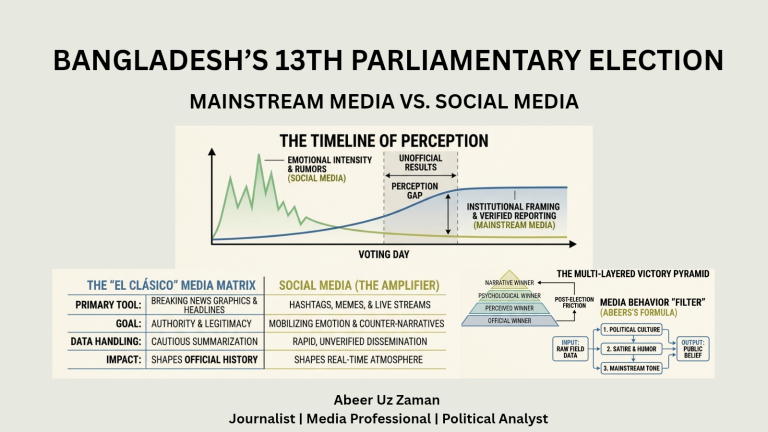
Across my journey in and around multiple media environments, I have witnessed how house policies in Bangladesh often compromise journalistic ethics in order to serve ownership interests. Most media institutions are owned by business conglomerates, corporate groups, or politically aligned individuals. As a result, ownership interests and political ideology frequently shape editorial decisions, which in turn can influence public opinion during elections and on major national issues.
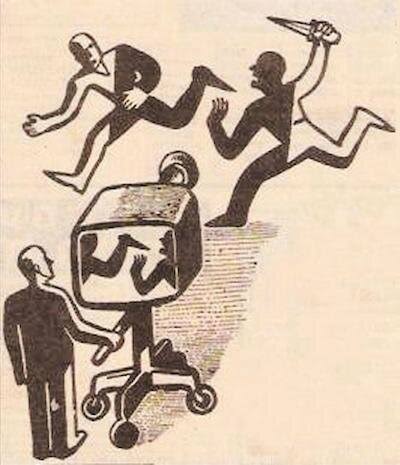
In some cases, media framing is used deliberately to shape public perception. In extreme cases, even communication logic resembling the “magic bullet” theory appears in the way messages are constructed and delivered to audiences—as though people can simply be injected with a ready-made political interpretation.
This is particularly dangerous in a country where literacy and media literacy do not mean the same thing. A person may be able to read, yet remain vulnerable to manipulation. In Bangladesh, low media and digital literacy make large portions of the population highly dependent on media narratives without the critical tools to question them. And when digitally vulnerable citizens increasingly depend on social media for news and information, the door opens even wider for organized framing, selective storytelling, and strategic misdirection.
In Bangladesh today, media outlets rely heavily on social and digital platforms for news distribution. That dependence creates both opportunity and danger: opportunity for faster public communication, and danger when truth becomes secondary to ownership, ideology, reach, or engagement.
For me, journalism is not simply about writing reports or publishing headlines. It is about defending the moral right of the public to know. It is about standing at the point where ethics confront fear. It is about choosing truth even when truth is inconvenient, dangerous, or unwelcome.
I did not choose journalism because it is easy. I chose it because it is difficult, because it demands courage, and because it remains one of the few professions through which conscience can still struggle openly against injustice.
That, above all, is why I chose journalism.