Why I Chose Journalism: Ethics, Courage, and a Personal Testimony
My interest in journalism is rooted in something deeper than qualifications, experience, or career ambition. It comes from my moral belief about what journalism is supposed to do in society.
My mother is a head teacher at a government primary school. She has always said, with pride and conviction, “A teacher’s child can never do wrong.” In her view, teaching is an ethical profession. All my life, I have tried my best to preserve the trust she placed in morality and conscience.
Over time, however, I came to feel that the moral reach of teaching, while noble, is somewhat limited in scale and often slow in visible impact.
Because of my father’s government posting, nearly five years of my childhood were spent in Chattogram. Perhaps the land of Masterda Surya Sen and Pritilata, surrounded by hills and sea, helped shape me into someone courageous, resilient, and willing to endure.
My mother also had a music teacher. She learned patriotic songs and often hummed songs of Bangladesh’s Liberation War.
I believe nature gave everything it had to make me who I am.
I have long believed that the highest profession through which one can practice morality with courage—and through that courage help create the path toward good governance and civil rights—is journalism.
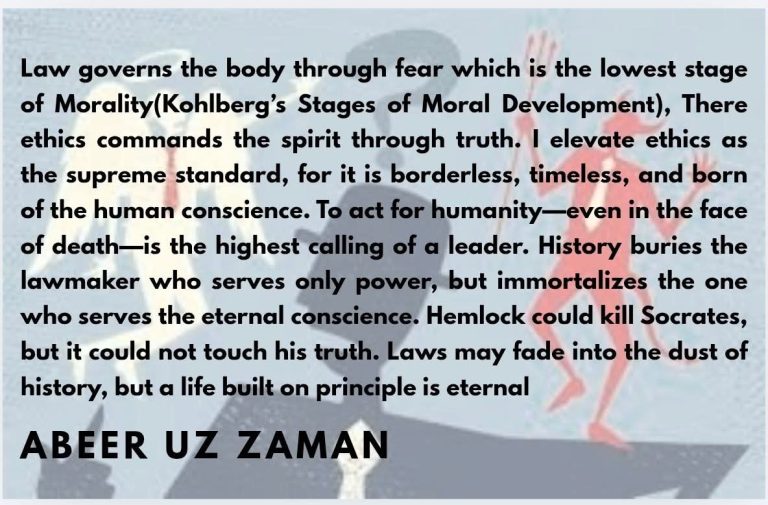
I believe people obey the law to avoid punishment, but people become moral through the philosophy of conscience. That is why, while many law-abiding people may remain at the lowest stage of Kohlberg’s moral development, I have always wanted to see myself at the highest stage.
I see journalism as 90 percent an ethical profession and only 10 percent a legal one.
If a false report is published, the law may be broken. But if a true report is deliberately not published, the law may not be broken—yet a terrible ethical collapse takes place in the journalist and in the media institution.
To me, suppressing a true report is a thousand times more dangerous than almost anything else.
I completed my undergraduate degree in Mass Communication and Journalism at Jagannath University. As a graduate of a public university, I have always believed that my education was not mine alone. It was made possible, in part, by the hard-earned tax money of the people of Bangladesh. Because of that, I have long felt a moral obligation to serve them through truth, accountability, and public-interest journalism.
It is therefore one of the deepest ironies of my life that while I was trying to act in service of the public, the case that followed was framed as State vs. Abeer Uz Zaman. In that contradiction, I saw something larger than my own suffering: the painful distance that can emerge between the people, in whose name the state exists, and a system that can sometimes move against those trying to serve them.
During my eighth and final semester internship, I worked at The Daily Inqilab. My supervisor was a kind man and, from what I saw and understood, an honest one.
One day, while I was sitting at his desk, I saw an investigative field report from a Faridpur/Shariatpur correspondent. It covered almost an entire page. The subject was: “A Market for Banned Mother Hilsa on the Sandbanks of the Padma.” A large red cross had been marked across the report. The editor had refused to publish it. The explanation, as it was communicated, was that publishing such a report at that moment would harm public sentiment in the context of the then interim government.
Naturally, my supervisor removed that part.
I argued with him. I said that the job of the media is to publish the truth. If the truth harms someone’s interests, then that should be understood as evidence that the person or group is doing something wrong.
He avoided the discussion by saying it was an instruction from above.
That day I understood something clearly: in this country, house policy is often driven by corporate and political ownership. It would not be possible for me to practice morality fully through my profession within such a structure.
In September 2025, on the advice of Dr. Abdul Kabil Khan, I enrolled in the MSS program in Journalism, Media and Communication at Daffodil International University in Savar, my home area.
At the same time, I began my own online news portal as Editor: Daily Dhaka Gazette.
My inspiration was Hicky’s Bengal Gazette.
I had prepared everything necessary for registration. But a personal assistant to a relevant ministry adviser demanded an under-the-table amount that left me genuinely shocked.
So I changed my plan.
I decided that I would publish a story so important that people across the country would talk about it. I wanted Dhaka Gazette to become a symbol of courage and truth.
Very soon, I found the issue.
Near Aminbazar in Savar stood a project known as Madhumati Model Town.
This housing project had been developed by filling in 550 acres of flood-reserve wetlands, in violation of waterbody protection laws.
In 2004, BELA challenged its legality through a writ petition. In 2005, the High Court declared the project illegal. In 2009, the Appellate Division upheld that decision. In 2012, the Supreme Court dismissed the review petition, effectively confirming the ruling.
Yet by 2025, despite that legal history, the project was reportedly rebranded as “Nandanik Housing,” while a parallel world of resorts, clubs, agro-businesses, and questionable activities grew inside it.
I quietly began collecting information from the relevant ministries and power authorities. I was moving toward a story that, in my view, could have shaken the country.
Then, on 26 September, sometime around 3:30 to 3:40 in the night, while I was asleep, I was suddenly jolted awake by torchlight and laser light aimed at me. By then, the intruders had already switched on the main lights from the control panel.
A dozen DB officers entered my room after breaking the lock on the flat. They searched everything frantically. My computer hard drive was removed immediately. My laptop was taken. My two mobile phones were seized.
They cross-checked my name, my mother’s name, and even my phone number to confirm my identity.
At one point, a man without a DB vest—whom I later understood to be the ADC of DB Motijheel and the leader of the operation—stood near my head. At that same moment, another DB member took out a pistol from a zipper bag with tissue and placed it beneath my mattress.
The ADC said to me, “Little brother, we know everything about you. Don’t create a scene. Come with us.”
My mother and younger sister were in one room, and I was in another. My father was then posted in Faridpur. When I tried to go to my mother, they stopped me. I forced my way toward her and called out.
After my mother opened the gate, they did not even give me one minute. They demanded my Dhaka Gazette Editor ID card. I handed it over.
They then said they were taking me for questioning. Several men grabbed me by the belt and almost lifted me into the ADC’s Hiace vehicle.
After the vehicle entered the highway, the ADC began asking me what I had been doing in the past few days and whether I had shared the documents with anyone.
I told him I had only just completed the documents and had not shared them with anyone.
As soon as I said that, he said, “This little brother is lying. Tie him up.”
Instantly, two DB members beside me pulled my hands behind my back, handcuffed me, and blindfolded me.
Later I was taken near the Aminbazar dumping-ground road, close to the project area. My blindfold was removed. The pistol was pushed into the front of my waist. I was pushed forward. One man cocked the pistol.
That was the closest moment to death I had ever experienced in this life.
I felt that perhaps I had already received in that moment all the fear that life had to offer me.
Then I accepted death.
They told me to run. I remained silent.
They told me again to run. I answered that my leg was broken.
Then they demanded to know who else I had given the documents to.
I replied that I had told them the truth.
After more threats, I was taken to the DB office at Minto Road.
During entry into the holding cell, I was asked what my political position was. I said, “None. I am a journalist.”
I was then asked where I had studied. I said, “Jagannath University.”
What happened to me afterward is something I choose to keep within myself.
But I can say this much: someone there wrote down, in their own hand, “Jagannath University Chhatra League.”
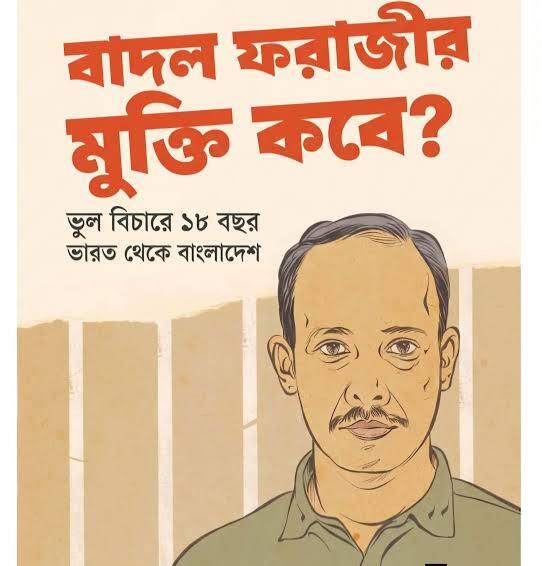
After keeping me disappeared for two or three days, they eventually produced me under the Anti-Terrorism Act.
After remaining missing for those days, I was transferred through the court to Keraniganj Jail.
The next day, over the prison loudspeaker, I heard my name called. I ran toward the meeting area.
My family—my mother, father, friends, and cousin—were waiting behind the bars.
Believe me, I had no tears in my eyes then. I was not even sad. Fear and pain seemed to have died inside me.
With a chest full of courage, I walked there singing.
Twelve days later, I was transferred to Kashimpur Jail.
I spent nearly 60 days in prison.
The interesting thing is that in Kashimpur Jail, I began mind-mapping an initiative for a prison newspaper or magazine called Karabarta, and I even received preliminary approval from the jailer.
The most valuable work done in my life was, strangely enough, done to me by those who tried to break me.
They reduced my fear to zero and turned my courage into one hundred.
I am a quick learner, and I also have relevant experience.
I worked as a Local Producer (TV) during the election under Sam Jahan.
I completed the Fact Checking Training for Journalism Students under USAID, MRDI, and Internews.
I have also shared the link to my personal website.
Everything can be learned. Skills can be acquired.
But ethics and courage—those are things a person is born with, and grows with.
My ability to read people, structures, motives, and networks is one of my greatest strengths.
This is why I remain committed to journalism—not as a career alone, but as the highest moral practice available to me.
My interest in journalism is rooted in something deeper than qualifications, experience, or career ambition. It comes from my moral belief about what journalism is supposed to do in society.
My mother is a head teacher at a government primary school. She has always said, with pride and conviction, “A teacher’s child can never do wrong.” In her view, teaching is an ethical profession. All my life, I have tried my best to preserve the trust she placed in morality and conscience.
Over time, however, I came to feel that the moral reach of teaching, while noble, is somewhat limited in scale and often slow in visible impact.
Because of my father’s government posting, nearly five years of my childhood were spent in Chattogram. Perhaps the land of Masterda Surya Sen and Pritilata, surrounded by hills and sea, helped shape me into someone courageous, resilient, and willing to endure.
My mother also had a music teacher. She learned patriotic songs and often hummed songs of Bangladesh’s Liberation War.
I believe nature gave everything it had to make me who I am.
I have long believed that the highest profession through which one can practice morality with courage—and through that courage help create the path toward good governance and civil rights—is journalism.
I believe people obey the law to avoid punishment, but people become moral through the philosophy of conscience. That is why, while many law-abiding people may remain at the lowest stage of Kohlberg’s moral development, I have always wanted to see myself at the highest stage.
I see journalism as 90 percent an ethical profession and only 10 percent a legal one.
If a false report is published, the law may be broken. But if a true report is deliberately not published, the law may not be broken—yet a terrible ethical collapse takes place in the journalist and in the media institution.
To me, suppressing a true report is a thousand times more dangerous than almost anything else.
I completed my undergraduate degree in Mass Communication and Journalism at Jagannath University. As a graduate of a public university, I have always believed that my education was not mine alone. It was made possible, in part, by the hard-earned tax money of the people of Bangladesh. Because of that, I have long felt a moral obligation to serve them through truth, accountability, and public-interest journalism.
It is therefore one of the deepest ironies of my life that while I was trying to act in service of the public, the case that followed was framed as State vs. Abeer Uz Zaman. In that contradiction, I saw something larger than my own suffering: the painful distance that can emerge between the people, in whose name the state exists, and a system that can sometimes move against those trying to serve them.
During my eighth and final semester internship, I worked at The Daily Inqilab. My supervisor was a kind man and, from what I saw and understood, an honest one.
One day, while I was sitting at his desk, I saw an investigative field report from a Faridpur/Shariatpur correspondent. It covered almost an entire page. The subject was: “A Market for Banned Mother Hilsa on the Sandbanks of the Padma.” A large red cross had been marked across the report. The editor had refused to publish it. The explanation, as it was communicated, was that publishing such a report at that moment would harm public sentiment in the context of the then interim government.
Naturally, my supervisor removed that part.
I argued with him. I said that the job of the media is to publish the truth. If the truth harms someone’s interests, then that should be understood as evidence that the person or group is doing something wrong.
He avoided the discussion by saying it was an instruction from above.
That day I understood something clearly: in this country, house policy is often driven by corporate and political ownership. It would not be possible for me to practice morality fully through my profession within such a structure.
In September 2025, on the advice of Dr. Abdul Kabil Khan, I enrolled in the MSS program in Journalism, Media and Communication at Daffodil International University in Savar, my home area.
At the same time, I began my own online news portal as Editor: Daily Dhaka Gazette.
My inspiration was Hicky’s Bengal Gazette.
I had prepared everything necessary for registration. But a personal assistant to a relevant ministry adviser demanded an under-the-table amount that left me genuinely shocked.
So I changed my plan.
I decided that I would publish a story so important that people across the country would talk about it. I wanted Dhaka Gazette to become a symbol of courage and truth.
Very soon, I found the issue.
Near Aminbazar in Savar stood a project known as Madhumati Model Town.
This housing project had been developed by filling in 550 acres of flood-reserve wetlands, in violation of waterbody protection laws.
In 2004, BELA challenged its legality through a writ petition. In 2005, the High Court declared the project illegal. In 2009, the Appellate Division upheld that decision. In 2012, the Supreme Court dismissed the review petition, effectively confirming the ruling.
Yet by 2025, despite that legal history, the project was reportedly rebranded as “Nandanik Housing,” while a parallel world of resorts, clubs, agro-businesses, and questionable activities grew inside it.
I quietly began collecting information from the relevant ministries and power authorities. I was moving toward a story that, in my view, could have shaken the country.
Then, on 26 September, sometime around 3:30 to 3:40 in the night, while I was asleep, I was suddenly jolted awake by torchlight and laser light aimed at me. By then, the intruders had already switched on the main lights from the control panel.
A dozen DB officers entered my room after breaking the lock on the flat. They searched everything frantically. My computer hard drive was removed immediately. My laptop was taken. My two mobile phones were seized.
They cross-checked my name, my mother’s name, and even my phone number to confirm my identity.
At one point, a man without a DB vest—whom I later understood to be the ADC of DB Motijheel and the leader of the operation—stood near my head. At that same moment, another DB member took out a pistol from a zipper bag with tissue and placed it beneath my mattress.
The ADC said to me, “Little brother, we know everything about you. Don’t create a scene. Come with us.”
My mother and younger sister were in one room, and I was in another. My father was then posted in Faridpur. When I tried to go to my mother, they stopped me. I forced my way toward her and called out.
After my mother opened the gate, they did not even give me one minute. They demanded my Dhaka Gazette Editor ID card. I handed it over.
They then said they were taking me for questioning. Several men grabbed me by the belt and almost lifted me into the ADC’s Hiace vehicle.
After the vehicle entered the highway, the ADC began asking me what I had been doing in the past few days and whether I had shared the documents with anyone.
I told him I had only just completed the documents and had not shared them with anyone.
As soon as I said that, he said, “This little brother is lying. Tie him up.”
Instantly, two DB members beside me pulled my hands behind my back, handcuffed me, and blindfolded me.
Later I was taken near the Aminbazar dumping-ground road, close to the project area. My blindfold was removed. The pistol was pushed into the front of my waist. I was pushed forward. One man cocked the pistol.
That was the closest moment to death I had ever experienced in this life.
I felt that perhaps I had already received in that moment all the fear that life had to offer me.
Then I accepted death.
They told me to run. I remained silent.
They told me again to run. I answered that my leg was broken.
Then they demanded to know who else I had given the documents to.
I replied that I had told them the truth.
After more threats, I was taken to the DB office at Minto Road.
During entry into the holding cell, I was asked what my political position was. I said, “None. I am a journalist.”
I was then asked where I had studied. I said, “Jagannath University.”
What happened to me afterward is something I choose to keep within myself.
But I can say this much: someone there wrote down, in their own hand, “Jagannath University Chhatra League.”
After keeping me disappeared for two or three days, they eventually produced me under the Anti-Terrorism Act.
After remaining missing for those days, I was transferred through the court to Keraniganj Jail.
The next day, over the prison loudspeaker, I heard my name called. I ran toward the meeting area.
My family—my mother, father, friends, and cousin—were waiting behind the bars.
Believe me, I had no tears in my eyes then. I was not even sad. Fear and pain seemed to have died inside me.
With a chest full of courage, I walked there singing.
Twelve days later, I was transferred to Kashimpur Jail.
I spent nearly 60 days in prison.
The interesting thing is that in Kashimpur Jail, I began mind-mapping an initiative for a prison newspaper or magazine called Karabarta, and I even received preliminary approval from the jailer.
The most valuable work done in my life was, strangely enough, done to me by those who tried to break me.
They reduced my fear to zero and turned my courage into one hundred.
I am a quick learner, and I also have relevant experience.
I worked as a Local Producer (TV) during the election under Sam Jahan.
I completed the Fact Checking Training for Journalism Students under USAID, MRDI, and Internews.
I have also shared the link to my personal website.
Everything can be learned. Skills can be acquired.
But ethics and courage—those are things a person is born with, and grows with.
My ability to read people, structures, motives, and networks is one of my greatest strengths.
This is why I remain committed to journalism—not as a career alone, but as the highest moral practice available to me.
This is a personal testimony written for restricted access as part of my professional and ethical background.