Trump’s Iran-War Messaging: Strength, Spectacle, and the Politics of Wartime Communication
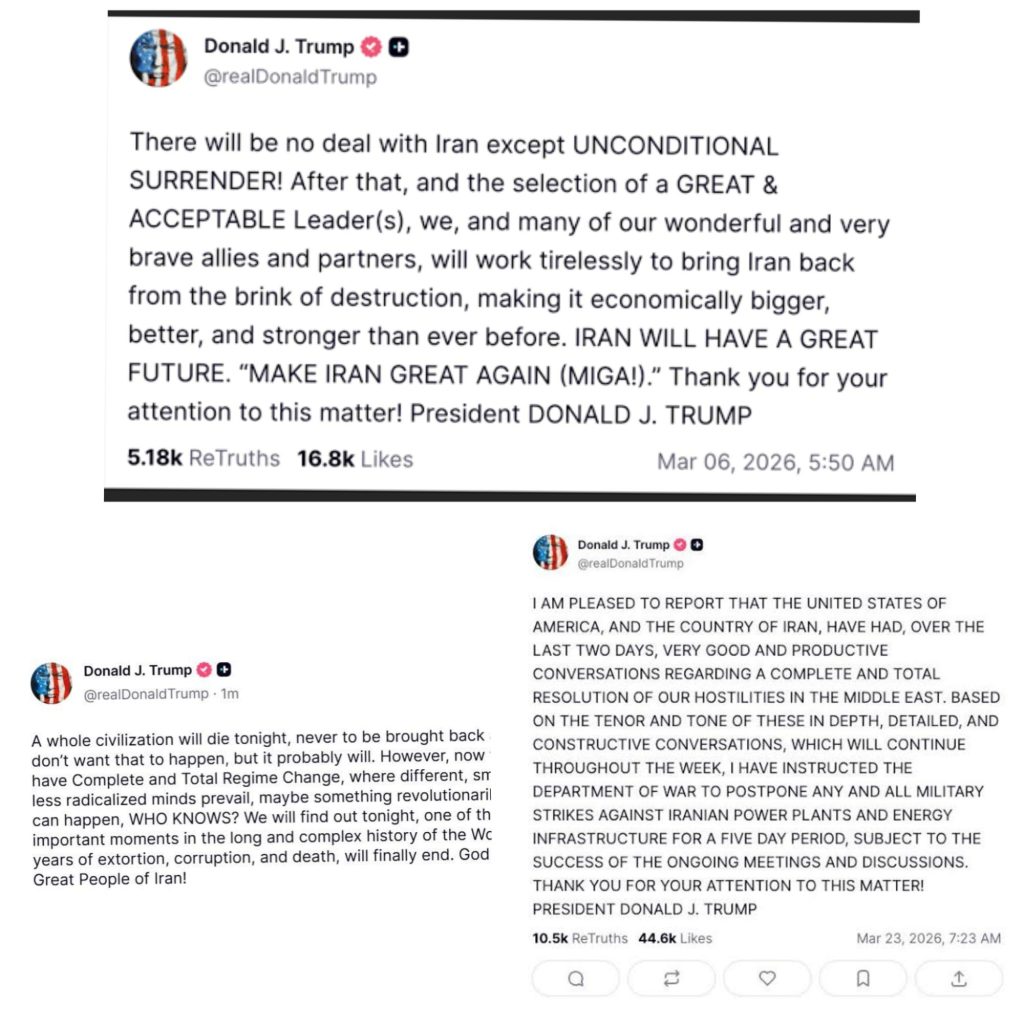
In wartime, communication is never just about information. It is also about power, fear, legitimacy, and control over public perception. That is what makes Donald Trump’s communication during the Iran conflict especially significant. His Truth Social posts and public rhetoric did not simply provide updates on events. They also worked to shape the political atmosphere around the conflict, frame the meaning of escalation, and place him at the center of the narrative.
From the beginning, Trump’s messaging style stood out for its clarity and intensity. It was not diplomatic in tone, nor was it cautious in wording. Instead, it relied on short, direct, emotionally charged statements that were easy for television, online news, and social platforms to amplify. In communication terms, that matters. Messages that are simple, dramatic, and emotionally loaded often travel faster than detailed policy explanations.
A key feature of Trump’s communication was its aggressive and leader-centered style. He projected himself as the decisive actor, the one setting deadlines, issuing warnings, and defining the conditions for de-escalation. This gave his messages a strong sense of authority. At the same time, it also turned the war into a stage for political performance. The communication was not only about Iran. It was also about Trump’s own image as a leader who acts quickly, speaks forcefully, and dominates the storyline.
This style served several purposes at once. First, it put psychological pressure on Iran by portraying the United States as ready and willing to continue military action. Second, it reassured domestic supporters by performing strength and control. Third, it generated immediate media attention. Phrases built around destruction, punishment, deadlines, and consequence are not neutral language. They are written to become headlines.
Another important dimension of Trump’s messaging was the attempt to justify and legitimize war. His language repeatedly framed Iran as the side responsible for escalation and the United States as acting out of necessity rather than choice. This is a common wartime communication strategy. Military force is presented not as aggression, but as a reluctant response to a dangerous threat. Conditional bargaining also played a role in this framing. When military action is linked to demands such as reopening the Strait of Hormuz, the message appears more strategic and controlled, even if the overall rhetoric remains highly dramatic.
Yet this legitimation was not complete. Trump’s communication was effective in creating emotional support, but weaker in explaining long-term strategic goals. The language often sounded more theatrical than carefully justified. It projected force successfully, but it did not always make the political end state clear. In that sense, the communication was strong as emotional legitimation, but less convincing as a fully reasoned strategic narrative.
This leads to a larger communication question: was the emphasis on activity or on effect? Trump’s messaging strongly favored visible activity. It highlighted threats, strikes, deadlines, troop presence, and pressure. It showed motion. It showed action. It showed intent. But it did not clearly demonstrate durable effect. Long-term political outcomes such as stability, deterrence, compliance, or settlement remained uncertain. That distinction matters because wartime communication often tries to confuse visible force with meaningful success.
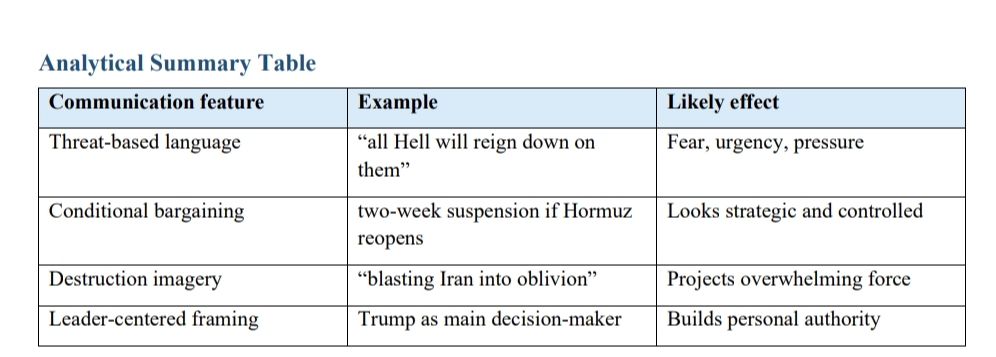
From a communication-analysis perspective, this is one of the most revealing aspects of the case. Activity is easier to dramatize than effect. It is easier to communicate bombing, deadlines, and retaliation than to communicate lasting strategic achievement. Trump’s rhetoric was therefore highly effective at projecting movement and pressure, but less effective at proving that such pressure had produced a stable outcome.
The issue of credibility is equally important. Trump’s messages were certainly memorable and persuasive for audiences already inclined to see him as strong and decisive. But credibility requires more than impact. It also requires consistency, realism, and a believable connection between words and outcomes. When communication becomes too dramatic, it may remain politically useful while becoming less credible as careful wartime messaging.
This does not mean the communication failed. On the contrary, it succeeded in performing power. It created signs of punishment, urgency, command, and control. It signaled dominance even when it left major political questions unresolved. That is precisely why this case matters. It shows that in conflict situations, communication can be successful as spectacle even when it is less successful as strategy.
Ultimately, Trump’s Iran-war messaging reveals how modern wartime communication operates at the intersection of politics, media logic, and psychological influence. It seeks not only to describe conflict, but to frame it emotionally, legitimize it publicly, and personalize it politically. The result is a style of communication that is powerful, highly shareable, and symbolically effective—but only partly credible when judged by the standards of careful, plausible, and strategically coherent public communication.
In the end, the case reminds us that wartime messaging is not just about what leaders say. It is about how they say it, why they say it that way, and what kind of reality they are trying to make audiences accept.