Semiotic Analysis of the “Distracted Boyfriend” Meme

Internet memes are often treated as jokes, entertainment, or passing trends. Yet many of them function as powerful communication tools. They simplify complex ideas, rely on instantly recognizable visual patterns, and allow people to communicate social, cultural, and political meaning with very little text. One of the clearest examples of this is the “Distracted Boyfriend” meme.
Originally based on a 2015 stock photo, the image later became one of the most widely reused meme formats online. Its lasting popularity comes from its simplicity. In a single frame, it presents a clear emotional situation that audiences can understand almost immediately. That instant recognizability is what makes it especially useful for semiotic analysis.
At the most basic level, the meme contains a small set of visual signs: a boyfriend turning around to look at another woman, a girlfriend standing beside him, the girlfriend’s shocked and angry expression, the passing woman, the boyfriend’s body posture, and the ordinary public street setting. On their own, these elements may appear ordinary. Together, however, they create a highly readable story about distraction, temptation, shifting attention, and emotional conflict. 1
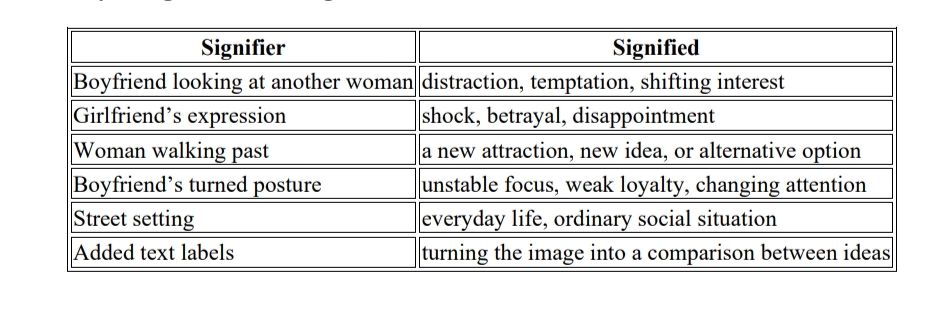
This is where semiotics becomes important. In semiotic terms, the meme works through the relationship between signifiers and signifieds. The boyfriend looking at another woman signifies distraction, temptation, and changing interest. The girlfriend’s expression signifies shock, betrayal, and disappointment. The woman passing by signifies a new attraction, a new idea, or an alternative option. Even the boyfriend’s turned posture suggests weak loyalty and unstable focus, while the street setting gives the entire image the feel of an ordinary everyday social scene. When text labels are added, the image becomes even more flexible, turning into a comparison between ideas, priorities, audiences, or institutions. 2
What makes the meme so effective is that the characters do not remain limited to their literal roles. The boyfriend is rarely understood only as a man in a relationship. In meme culture, he often represents a voter, a consumer, a media audience, a student, an institution, or the public itself. The girlfriend usually stands for the original commitment, existing loyalty, old preference, or current responsibility. The passing woman becomes the new attraction, new trend, new narrative, new issue, or more exciting alternative. Through this transformation, the meme moves far beyond humor and becomes a broad visual metaphor. 3
Several recurring themes make the meme especially adaptable: distraction, temptation, changing priorities, disloyalty, curiosity toward something new, and conflict between the old and the new. These themes are simple enough to be widely understood, but also broad enough to be applied in many different fields. The same image can be used to explain entertainment choices, media behavior, political shifts, public opinion, consumer preference, educational interest, or personal habits. That flexibility is one of the main reasons for its endurance in digital culture. 4
The meme is also powerful because it tells a complete story in one frame. Audiences do not need a long explanation to understand the tension. The boyfriend is visibly distracted. The girlfriend is visibly offended. The passing woman is visibly the focus of sudden attention. In this way, body language and facial expression do much of the communicative work before any caption is added. Once labels are introduced, the meme can easily be turned into a commentary on shifting public attention, changing loyalty, or the attraction of a new message.
This makes the meme particularly useful in media studies, politics, and public relations. In political communication, the boyfriend can represent voters who shift their attention from one party to another. In media studies, he can stand for audiences moving away from one issue toward a more emotionally attractive topic. In public relations, the meme can illustrate how public attention leaves one message and turns toward another more appealing or sensational narrative. The format is so widely usable because its emotional logic is already familiar to most people.
From a cultural perspective, the meme reflects how online communication often works today. Digital audiences usually prefer content that is visual, quick, emotional, and easy to process. The “Distracted Boyfriend” meme fits all of these qualities. It does not require deep explanation to be understood. Instead, it compresses meaning into a single emotionally charged visual moment.
The meme also demonstrates a central semiotic principle: meaning does not emerge from isolated signs alone, but from the relationships among them. The boyfriend by himself would not fully signify distraction. The girlfriend alone would not fully signify loyalty or betrayal. The passing woman alone would simply be another figure in the image. But when these signs are placed together in a specific visual relationship, they generate a clear and widely shareable meaning. This is exactly why the meme works so effectively as a semiotic artifact. 5
Another reason for its power is that it depends on shared social understanding. Most audiences already recognize feelings such as attraction, jealousy, surprise, divided attention, and emotional conflict. Because these emotions are culturally familiar, the meme becomes highly adaptable across contexts. It can be funny, critical, political, ironic, or analytical depending on the text attached to it.
Ultimately, the “Distracted Boyfriend” meme is more than a viral image. It is a strong example of how simple visual signs can communicate broad and complex meanings. Its effectiveness lies not in a single character or gesture, but in the interaction among all the signs in the frame. That is what makes it both a successful meme and a valuable example for semiotic analysis.
In the end, the meme reminds us that digital culture often communicates through compressed visual narratives. A single image, when structured through recognizable signs and familiar emotional patterns, can say far more than a long explanation. That is why the “Distracted Boyfriend” meme remains one of the clearest examples of how memes function as modern semiotic communication.