Propaganda as PR? AI “Lego” Videos, Virality, and Wartime Communication
A monitoring-based article on new media public relations, framing, propaganda, and the platform logic of wartime communication.
Propaganda as PR? AI “Lego” Videos, Virality, and Wartime Communication During the Iran War
A monitoring-based article on new media public relations, framing, propaganda, and the platform logic of wartime communication.
This article was written as a monitoring-based academic analysis of wartime communication, propaganda, framing, and digital virality in the platform era.
Abstract
This paper examines the wave of AI-generated “Lego-style” propaganda videos that circulated during the Iran war and argues that they can be understood as a form of strategic communication in which propaganda increasingly borrows the methods of public relations. Rather than treating the clips only as misinformation, internet humor, or technological novelty, the paper approaches them as attention-seeking political messages designed for platform circulation. The analysis combines a qualitative monitoring method with a theoretical discussion of semiotics, framing, virality, and credibility. It compares how several influential sources discussed the same phenomenon, especially The New Yorker, TIME, the Associated Press, Reuters, and selected background readings on propaganda history and technique. The paper argues that the videos became effective because they combined familiar pop-culture signs, strong emotional cues, and a format that moved easily across digital platforms. Their power did not depend only on literal belief. It also depended on how widely they were shared, how quickly they were understood, and how effectively they turned war into symbolic online spectacle. The case therefore shows that in the platform era, propaganda and public relations are no longer separated by a clear boundary. Both now compete through branding, visual identity, emotional resonance, speed, repetition, and audience adaptation.
Keywords
AI propaganda; public relations; framing; semiotics; virality; Iran war; digital communication; media monitoring
- Introduction
The spread of AI-generated “Lego-style” propaganda during the Iran war offers an unusually clear example of how political communication is changing in a platform-driven media environment. These videos portrayed war, missiles, cities, politicians, and national enemies in a toy-like visual language that looked playful on the surface but carried highly political messages underneath. Major outlets described them as bizarre, low-cost, viral, and effective. They circulated through social media, were re-shared by politically aligned accounts, and attracted attention far beyond the immediate battlefield. What makes the case important is not only that the content was synthetic. It is that the synthetic form was used strategically to package conflict in a way that felt instantly legible to online audiences (Chayka, 2026; DiResta, 2026).
This topic fits the study of new media public relations because the videos do not operate like old government statements or formal press releases. They operate more like branded content. They have a recognizable style, a clear emotional tone, a target audience, and a built-in logic of repetition and shareability. In that sense, they resemble public relations campaigns that attempt to capture attention, frame an issue, and manage how audiences interpret events. At the same time, their purpose is openly political, conflict-driven, and manipulative, which places them firmly within the field of propaganda. The overlap between propaganda and public relations is therefore central to the problem rather than secondary to it.
The phrase “propaganda as PR” is useful because it draws attention to this overlap. Public relations is often associated with reputation management, persuasion, stakeholder influence, and message design. Propaganda, by contrast, is often associated with manipulation, mobilization, ideological conflict, and emotional simplification. In a digital war, however, the techniques begin to merge. Messages are crafted for visibility, symbolic impact, and public alignment. The same communication logic that sells a brand can also package a geopolitical narrative. This is one reason the case deserves close attention within communication studies.
This paper asks one main question: how can the Lego-style videos be understood as a form of strategic communication that combines propaganda and public-relations logic in the context of the Iran war? To answer that question, the paper follows a structure similar to the academic sample provided by the course instructor. It begins with a brief historical and conceptual background on propaganda, then reviews the most relevant scholarship and source material, explains the method, presents the case analysis, and closes with a discussion of the broader implications. The overall argument is that the videos became effective because they transformed war into a platform-native visual format built around symbolic clarity, emotional accessibility, and rapid circulation.
- Background: Propaganda, PR, and the Historical Communication Problem
The word propaganda has a much older history than social media. Etymonline traces the term to the Latin root connected to propagation and to the seventeenth-century Catholic institution Congregatio de Propaganda Fide, originally concerned with spreading faith rather than with the purely negative modern sense of manipulation (Etymonline, n.d.). This history matters because it reminds us that propaganda has always involved organized attempts to spread a worldview, not merely the telling of lies. Over time, especially in the modern political era, the term became strongly connected to wartime persuasion, ideological messaging, and mass influence.
A classic twentieth-century example is the Committee on Public Information in the United States during World War I. Smithsonian’s historical account of Woodrow Wilson’s propaganda machinery shows how government communication, press management, patriotic messaging, and public persuasion were deliberately coordinated in the service of war. The article argues that the Committee on Public Information represented one of the earliest large-scale modern information operations in American political life and blurred the boundaries between journalism, state messaging, and patriotic mobilization (McGerr, 2017). This example is important for the present paper because it demonstrates that propaganda has long shared practical ground with what would later be described as public relations.
The boundary between propaganda and public relations has therefore never been as clean as professional rhetoric sometimes suggests. Both involve selective messaging, narrative design, the strategic use of emotion, and attempts to secure public consent or at least reduce public resistance. The difference often lies in context, declared purpose, and ethical framing. Yet in wartime communication, the same tools appear repeatedly: simplification, repetition, symbolic contrast, moral polarization, and claims to legitimacy. The Iran-war case is contemporary, digital, and AI-assisted, but its deeper communication logic has historical predecessors.
At the same time, the current case is also clearly different from older propaganda systems. The Committee on Public Information operated through speeches, pamphlets, news relations, posters, and films. The Lego-style videos operated through memes, short-form platform distribution, AI-assisted visual production, irony, remix culture, and algorithmic visibility. This shift does not cancel the history; it updates it. What once required central institutions and industrial-scale media now also involves decentralized networks, synthetic production tools, and audiences who participate by sharing, commenting, mocking, or re-editing the content. In this environment, virality becomes part of communication power itself.
- Literature Review
A useful theoretical starting point is framing theory. Framing refers to the way communicators select certain aspects of reality, emphasize them, and thereby shape how people interpret an issue. Chong and Druckman (2007) describe framing as a process through which people develop a specific understanding of a political problem. Entman (2007) similarly argues that framing highlights particular definitions, causes, moral evaluations, and remedies. Framing is therefore not just description. It is organized emphasis. In wartime communication, this matters because war is rarely discussed in neutral language. It is framed as self-defense, retaliation, peace enforcement, anti-terrorism, humanitarian necessity, or civilizational struggle, depending on the speaker and the intended audience.
The professor’s sample article on Trump’s Truth Social framing of the 12-Day War against Iran uses this insight to show how online statements were used to justify and legitimize military action, and later to reframe withdrawal or escalation in politically favorable terms (Simons, n.d.). That sample is important here not as a direct source on the Lego videos, but as a model of how political communication during conflict can be studied through framing. It also demonstrates the importance of moving from raw message collection to structured interpretation.
Semiotics provides a second major lens. Berger’s discussion of signifiers, signifieds, relations, and connotations is particularly relevant because the Lego videos rely heavily on visual coding rather than factual exposition. The videos use toy-like figures, bright colors, exaggerated destruction, parody music, and caricatured leaders. These are not neutral design choices. They are signs that produce meaning through contrast and association. Berger argues that meaning does not rest in isolated elements but in the relationships among them. A sign gains force because it belongs to a broader system of differences and cultural codes (Berger, 2010). This is exactly what happens in the Lego videos: childish playfulness is brought into relation with war and death, producing an emotionally charged symbolic contradiction.
Intertextuality also matters. Berger notes that media texts often borrow from other texts and genres, and this is particularly true in digital culture. The Lego videos do not speak in the formal language of state television. They borrow from children’s animation, internet meme culture, gaming aesthetics, rap performance, parody, and protest symbolism. This borrowing is not decorative. It is what makes the message instantly readable to contemporary audiences who are already fluent in these media forms. The propaganda works partly because it speaks the audience’s existing visual language.
The most current discussion of this logic appears in the journalism and commentary surrounding the Iran-war videos themselves. The New Yorker emphasizes the cultural absurdity of the clips: toy-like visuals attached to deadly serious geopolitical violence. It also discusses the group behind the videos, their self-presentation, and the way their work traveled through Iranian, Russian, and Western digital spaces (Chayka, 2026). TIME develops a more conceptual argument by claiming that in the age of generative AI, virality is no longer merely a by-product of propaganda; it can be the message’s main strategic success (DiResta, 2026).
Associated Press contributes a more evidence-focused angle. It reports that pro-Iran groups used English-language AI content to shape the narrative of the war for Western audiences, and it notes that analysts suspected some degree of regime alignment or support because of the sophistication of the materials and the constraints of the Iranian internet environment (McNeil, 2026). Reuters adds yet another layer by covering official accusations, verification problems, and the wider uncertainty of the wartime information environment. Its reporting is valuable because it resists collapsing every claim into either full truth or full fabrication. Instead, it points to the contested nature of digital conflict (Reuters, 2026).
For this paper, these bodies of literature and reporting come together around one common insight: communication power in the platform era depends increasingly on attention, symbolic clarity, and emotional fit. This does not make factual evidence irrelevant. It does, however, mean that messages can become influential before their factual status is settled. That condition is especially dangerous in war, because emotional circulation often outruns verification.
- Methodology
This paper uses a qualitative monitoring approach. Rather than scraping thousands of posts across every platform, it works with a smaller set of high-value materials that help explain how the same communication phenomenon was interpreted in different ways. The monitored materials include: one interpretive long-form article from The New Yorker; one conceptual essay from TIME; one straight-news report from the Associated Press; one Reuters report focused on verification and information-war claims; background sources on propaganda history and terminology; and the professor’s sample article on Trump’s Truth Social framing as a model for wartime communication analysis. The method is designed to be manageable, transparent, and appropriate for a course assignment rather than an industrial-scale dataset study.
The source-selection logic is straightforward. The New Yorker was included because it explains the symbolic and stylistic features of the videos in detail. TIME was included because it supplies a conceptual argument about virality as propaganda logic. AP was included because it focuses on network behavior, English-language targeting, and likely political alignment. Reuters was included because it helps anchor the analysis in a verification-sensitive news style. The background sources were included because the paper is not only about one current event. It is also about a longer communication tradition linking propaganda, public persuasion, and media management.
The analysis was conducted in three steps. First, each source was read for its central claim, its tone, and the main communication dimension it emphasized. Second, recurring communication features were coded manually, especially interpretive framing, attribution caution, cultural analysis, event or verification focus, audience adaptation, and virality logic. Third, these observations were linked to theoretical concepts from the literature review, especially framing, semiotics, intertextuality, and propaganda history. The aim was not to prove one article right and another wrong. The aim was to compare what each source helped make visible.
This method has limits. It does not establish the original source of every video with forensic certainty. It does not measure direct effects on public opinion. It does not provide a technical audit of AI generation techniques. It also cannot represent the totality of posts across all platforms. What it can do is offer a structured communication analysis of how the content worked symbolically, how it was publicly framed, and why it circulated so effectively. For the purposes of a 4,000–5,000-word academic assignment, that is a realistic and defensible scope.
Table 1. Monitored sources and their main communication role
The New Yorker — Interpretive / cultural. Explains symbolism, absurdity, and platform meaning. Less focused on formal verification.
TIME — Conceptual / argumentative. Explains why virality matters as propaganda. Less detailed on attribution.
Associated Press — Straight news / monitoring. Strong on targeting, networks, and war narrative. Less deep on symbolic analysis.
Reuters — Verification-focused reporting. Strong caution on what can and cannot be verified. Narrower on cultural interpretation.
- Case Background: The Iran War as a Communication Environment
The Lego-style videos appeared in a highly charged communication environment. The Iran war was already being narrated through threats, counter-threats, symbolic escalation, claims of victory, accusations of disinformation, and dramatic online performances by leaders and aligned media actors. The professor’s sample article on Trump’s Truth Social framing of the 12-Day War shows how wartime communication can be theatrical, emotionally saturated, and designed to justify or legitimize changing policy moves in real time (Simons, n.d.). Even though the sample focuses on a different phase of the conflict, it is useful because it demonstrates how online political communication became part of the war itself rather than merely commentary about it.
This wider context matters because propaganda rarely succeeds in a vacuum. It gains force when it enters an already emotionalized information space. The Lego clips did not ask audiences to become interested in war from zero. They entered a moment when users were already scrolling through strikes, speeches, ceasefire rumors, conspiracy claims, and partisan outrage. Under those conditions, a format that looked simple, toy-like, and emotionally coded could travel quickly. It offered viewers not detailed explanation but an immediate emotional map of the conflict.
The videos also fit the habits of platform culture. Digital audiences are now highly accustomed to consuming politics in condensed visual formats: memes, short clips, ironic captions, symbolic mashups, and algorithm-ready edits. In such an environment, a bizarre but legible video often performs better than an official statement or a long policy explanation. The issue is not only what is said. It is whether the message fits the pace and grammar of platform circulation. The Lego-style videos clearly did.
- Findings and Analysis
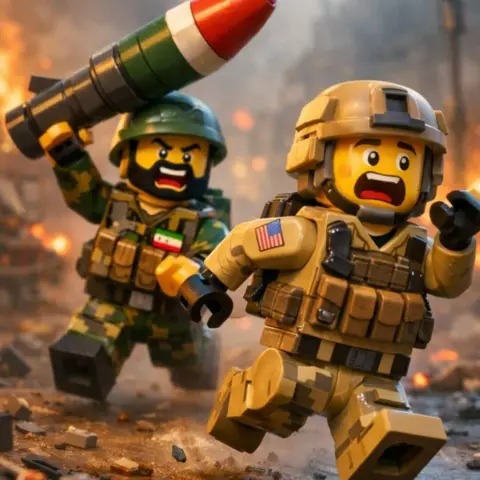
The first level of analysis concerns form. At the level of the visible signifier, the videos are playful. They use bright colors, toy-like proportions, familiar blocky movement, exaggerated visual action, caricatured public figures, and catchy AI-generated sound. These features suggest childishness, parody, fun, and harmless entertainment. Yet the signified content is war: missiles, flames, graves, collapsing buildings, anti-American rage, and mocked political leaders. The symbolic effect emerges from the collision between these two levels. The format lowers immediate emotional resistance, but it does not remove seriousness. It repackages seriousness as spectacle.
This is why semiotics is so useful here. The toy form is not politically innocent. It acts as a delivery system. The videos are easier to approach because they look familiar and unserious at first glance. But once the viewer enters the clip, the message is already framed in emotionally simple and morally polarized terms. There are heroes and villains, humiliation and revenge, collapse and triumph. Political complexity is compressed into a fast symbolic script. Berger’s point that meaning is relational becomes especially clear here. The same missile or grave would feel different in another style. It is the relation between toy aesthetics and real violence that makes the message memorable (Berger, 2010).
The second level of analysis concerns framing. The monitored sources collectively show that the Lego clips frame the conflict as a morally obvious struggle rather than as a complex geopolitical dispute. They do not foreground legal argument, historical background, or policy trade-offs. Instead, they foreground ridicule, emotional clarity, symbolic revenge, and immediate narrative satisfaction. That is consistent with propaganda logic. It is also consistent with modern PR logic, where messages are often simplified into emotionally resonant frames designed to travel quickly. Here again the overlap between the two becomes visible.
A third analytical issue is audience adaptation. AP’s report is especially helpful because it notes that the content was produced in English and used symbols familiar to Western internet culture. That is not a minor detail. It means the communication was designed with receiver-side fluency in mind. The senders did not remain within an internal ideological vocabulary. They built content in the language of global platform culture: memes, irony, visual exaggeration, anti-Trump symbolism, and pop-culture parody (McNeil, 2026). From a PR standpoint, this is classic targeting. A message becomes more persuasive when it feels like it already belongs to the audience’s media environment.
The fourth issue is virality. DiResta’s TIME essay is persuasive because it explains why synthetic propaganda can succeed even when viewers know it is synthetic. Users share content for many reasons: because it is funny, disturbing, useful for their own politics, aesthetically unusual, or simply hard to ignore. That means a message can gain influence through circulation even if its truth claims are unstable. In this sense, virality becomes not just a distribution outcome but a communication objective in its own right (DiResta, 2026). The videos succeeded partly because they invited reaction from multiple directions: support, mockery, criticism, fascination, and alarm.
A fifth issue is credibility. Reuters is crucial here because it introduces caution into a discussion that could otherwise become too symbolically saturated. If everything is treated only as sign and virality, analysis may lose contact with evidentiary boundaries. Reuters’ reporting reminds us that wartime communication is full of accusation, exaggeration, and partial verification. That caution does not weaken the argument of this paper. It strengthens it. It shows that propaganda power today often works precisely in the space between proof and spread. Content can travel, frame, and mobilize even while journalists are still trying to establish what is verified and what is not (Reuters, 2026).
Finally, the videos can be read as propaganda that borrows the practical strengths of public relations. They carry a recognizable visual identity. They are emotionally direct. They are designed for audience recall. They are easy to repost. They reduce complex conflict into digestible symbolic units. And they try to reposition the sender’s side as culturally fluent, clever, youthful, and narratively dominant. These are all communication achievements that PR professionals would recognize, even though the political purpose in this case is openly combative.
Table 2. Propaganda logic and PR logic in the Lego-style video format
Visual identity — Consistent Lego-style look, repeated character design, bright colors. Why it matters: creates instant recognition. PR overlap: comparable to brand style consistency.
Emotional tone — Mockery, urgency, revenge, ridicule. Why it matters: keeps viewers reacting and sharing. PR overlap: comparable to reputation and mood management.
Audience targeting — English language, Western pop-culture cues, anti-Trump references. Why it matters: makes propaganda legible to outside audiences. PR overlap: comparable to segmented messaging.
Shareability — Short, remixable, visually simple, easy to repost. Why it matters: turns viewers into distributors. PR overlap: comparable to engagement strategy.
Narrative simplification — Heroes, villains, humiliation, retaliation. Why it matters: reduces complexity into memorable frames. PR overlap: comparable to campaign message discipline.
- Discussion
Several broader implications follow from the case. First, propaganda has become deeply entangled with entertainment form. The Lego videos do not ask audiences to enter a sober civic space. They meet users inside the habits of contemporary digital media, where parody, absurdity, and irony are often more visible than official language. This matters because it changes the path of persuasion. A viewer may first consume the content as spectacle and only later register its political implications. In practical terms, the emotional doorway comes before reflective evaluation.
Second, the case shows that audience participation is now built into propaganda power. In older models, propaganda often moved from centralized sender to relatively passive receiver. In today’s digital environment, audiences actively help messages travel. They share, remix, caption, mock, and argue with content. Even negative engagement can increase visibility. This means that the communication success of propaganda can no longer be measured only by agreement or obedience. It must also be measured by reach, reuse, agenda influence, and symbolic presence.
Third, the case suggests that communication scholars should think more carefully about the overlap between propaganda and strategic communication. In professional discourse, PR often presents itself as transparent, relationship-centered, and ethically bounded. Yet the practical tools of modern PR—branding, message discipline, emotional positioning, audience adaptation, and visual identity—can also be used in highly manipulative and conflict-driven settings. This does not mean PR is equivalent to propaganda in every case. It does mean that their techniques are often transferable, especially in high-speed digital environments.
Fourth, the case raises a serious ethical issue. When war is packaged through toy-like imagery and meme-friendly aesthetics, violence can become easier to circulate than to understand. The form may increase visibility, but it may also reduce the felt weight of suffering. This does not mean stylized communication is automatically illegitimate. It means format itself must be taken seriously. As this case shows, how a message looks is not separate from what it does.
Finally, the case has practical implications for media literacy. Fact-checking remains necessary, but it is not sufficient. Audiences also need literacy in symbolism, framing, virality, and platform logic. They need to ask not only “Is this true?” but also “Why does this look like this?”, “Who is this designed for?”, “Why is it easy to share?”, and “What emotional reaction is it trying to produce?” Those questions are increasingly essential in an era where communication influence is often aestheticized before it is argued.
- Conclusion
The AI-generated Lego-style videos discussed in this paper should be understood as more than internet jokes, more than low-cost synthetic media, and more than isolated propaganda artifacts. They represent a platform-native form of strategic communication in which propaganda increasingly borrows the methods of public relations. Their effectiveness came from the combination of a familiar visual code, emotional clarity, narrative simplification, and easy circulation. The videos did not need to persuade every viewer in a literal sense. They only needed to become visible, memorable, and reusable enough to shape the symbolic environment of the war.
Seen through framing theory, the videos compressed conflict into emotionally direct moral narratives. Seen through semiotics, they used playful signifiers to carry deeply political and violent signifieds. Seen through a PR lens, they borrowed the practical logic of branding, targeting, repetition, and audience adaptation. These three perspectives together help explain why the phenomenon matters.
The broader lesson is that communication power in digital conflict now depends not only on institutional authority or factual precision, but also on style, speed, shareability, and symbolic fit. In that environment, propaganda and PR are not identical, but they increasingly operate with overlapping techniques. For scholars and students of media, the challenge is therefore not only to identify falsehood, but to understand format, circulation, and strategic meaning. The Lego-video case demonstrates that this challenge is no longer secondary. It is central to contemporary communication analysis.
References
Barrett, B. (2017, August 28). The ‘Distracted Boyfriend’ meme’s photographer explains all. WIRED. https://www.wired.com/story/distracted-boyfriend-meme-photographer-interview/
Berger, A. A. (2010). Semiotic analysis. In Techniques of interpretation. Uploaded PDF.
Chayka, K. (2026, April 8). The team behind a pro-Iran, Lego-themed viral-video campaign. The New Yorker. https://www.newyorker.com/culture/infinite-scroll/the-team-behind-a-pro-iran-lego-themed-viral-video-campaign
Chong, D., & Druckman, J. N. (2007). Framing theory. Annual Review of Political Science, 10, 103–126.
DiResta, R. (2026, April 2). When virality is the message: The new age of AI propaganda. TIME. https://time.com/article/2026/04/02/when-virality-is-the-message-the-new-age-of-ai-propaganda/
Entman, R. M. (2007). Framing bias: Media in the distribution of power. Journal of Communication, 57(1), 163–173.
Etymonline. (n.d.). Propaganda. https://www.etymonline.com/word/propaganda
McGerr, M. (2017, April 28). How Woodrow Wilson’s propaganda machine changed American journalism. Smithsonian Magazine. https://www.smithsonianmag.com/history/how-woodrow-wilsons-propaganda-machine-changed-american-journalism-180963082/
McNeil, S. (2026, April 9). Pro-Iran groups have used AI to troll Trump and try to control the war narrative. Associated Press. https://apnews.com/article/6622aa77b833cbd470b53ed7d43be9bd
Reuters. (2026, March 16). Trump accuses Iran of using AI to spread disinformation. Reuters. https://www.reuters.com/business/media-telecom/trump-accuses-iran-using-ai-spread-disinformation-2026-03-16/
Simons, G. (n.d.). Trump’s Truth Social framing of the 12-day war against Iran. Uploaded manuscript.
Tewksbury, D., & Scheufele, D. A. (2019). News framing theory and research. In Media effects: Advances in theory and research (4th ed.).
University of Vermont. (n.d.). Types of propaganda. https://www.uvm.edu/~jleonard/AGRI183/propoaganda.html