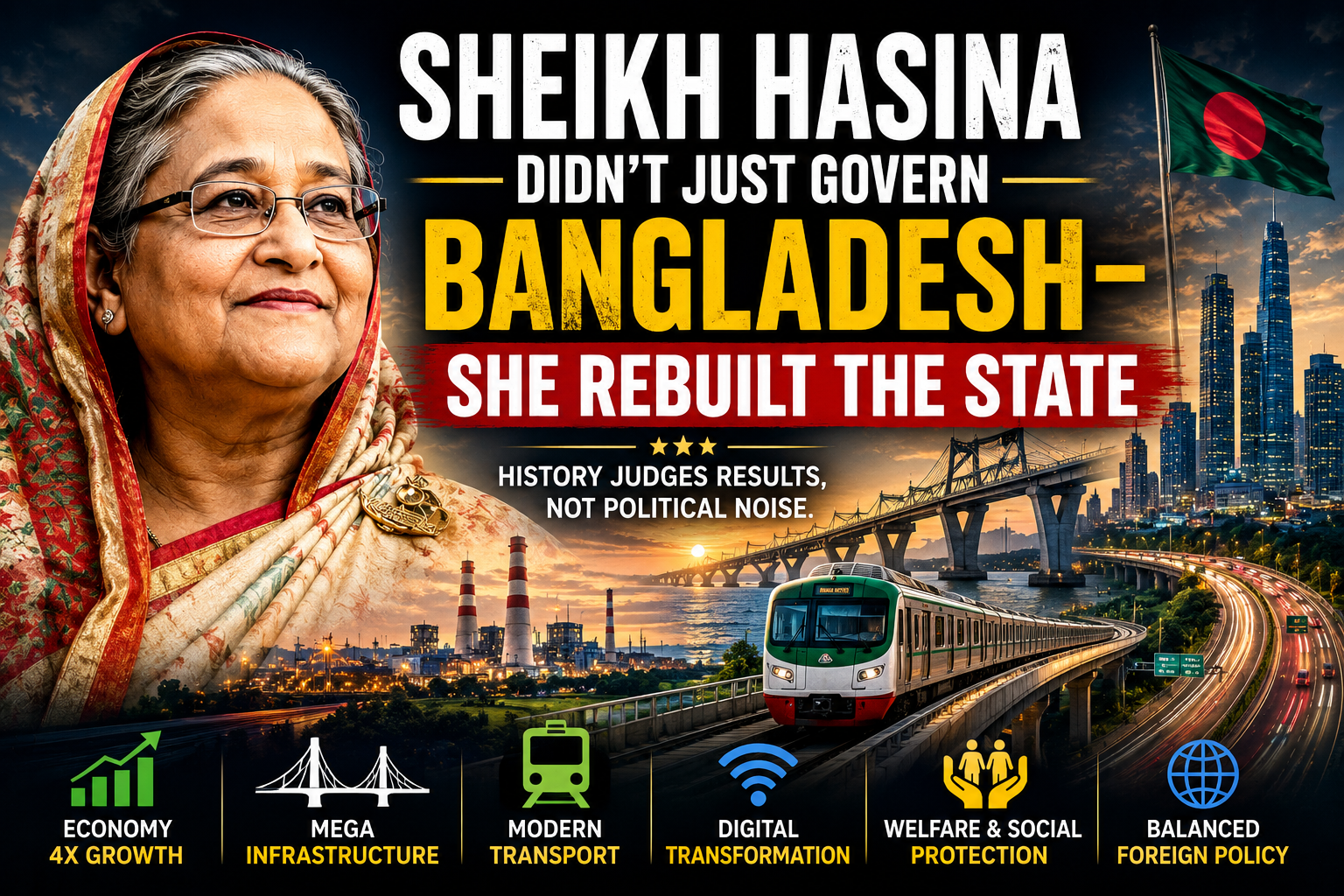
Sheikh Hasina Didn’t Just Govern Bangladesh —She Rebuilt The State
Beyond Political Narratives: State Transformation, Governance Continuity, and How History May Ultimately Remember Bangladesh in the Sheikh Hasina Era
History has always possessed one characteristic that distinguishes it fundamentally from politics: it is patient. Political discourse, by its nature, is immediate, emotional, reactive, and often deeply consumed by the urgency of the present moment. Nations living through periods of intense political contestation naturally become absorbed by the conflicts unfolding around them. Public debate focuses on controversy because controversy is immediate. Citizens argue over ideology, power struggles, opposition movements, institutional disputes, electoral legitimacy, leadership decisions, and the endless cycle of accusations and counter-accusations that define political competition in virtually every society. Yet history has never judged nations or leaders according to the same criteria that dominate political debate while events are unfolding.
Historians operate differently. Political scientists operate differently. Serious international governance scholars operate differently. They do not begin by asking who won the loudest argument in public discourse or which political narrative dominated media cycles during a particular period. Instead, history waits. It allows political emotion to fade. It allows partisan narratives to lose urgency. It allows temporary conflict to disappear into the background. Then, and only then, does history return to ask the single question that has ultimately determined the legacy of political leadership throughout modern civilization: when this leadership period ended, was the nation fundamentally stronger than before, or weaker than before?
This distinction between contemporary political perception and long-term historical judgment explains why societies frequently misunderstand their own historical turning points while living through them. Political eras that feel overwhelmingly controversial in the present often look profoundly different decades later. Leaders who dominate polarizing debate during their own time are sometimes remembered by future generations less for the arguments surrounding them and more for the institutional changes they left behind. Conversely, governments widely celebrated in their own era sometimes fade into historical irrelevance because, despite temporary popularity, they failed to leave behind lasting structural transformation capable of permanently altering the trajectory of the state itself.
Few regions illustrate this phenomenon more clearly than Asia’s great development stories of the twentieth and early twenty-first centuries. Singapore’s transformation under Lee Kuan Yew unfolded amid criticism, ideological resistance, and fierce debates over governance methods, yet later generations study Singapore not primarily through the lens of its political controversy but through the extraordinary institutional transformation that reshaped a vulnerable island city-state into one of the world’s most advanced economies. South Korea’s rapid industrialization similarly emerged through deeply contested political conditions, but history remembers the economic transformation more than the daily controversies that accompanied it. China’s rise under decades of uninterrupted economic restructuring fundamentally altered the global order, and despite immense internal and external criticism across multiple periods, economic historians overwhelmingly focus on the scale of structural transformation rather than the controversies that surrounded each phase of that transition. Vietnam, Malaysia, Indonesia, and even modern Rwanda increasingly demonstrate the same pattern. Political conflict dominates the present. Structural transformation dominates history.
It is through this broader analytical framework that the recent history of Bangladesh deserves examination, particularly the fifteen-year period under Sheikh Hasina’s leadership between 2009 and 2024. Regardless of one’s political interpretation, ideological preference, or perspective on the controversies naturally accompanying any prolonged governing period, one reality remains impossible for serious observers of international development to ignore. Bangladesh during this era underwent one of the most significant structural transformations in its modern history, and the scale of this transformation increasingly demands evaluation not through temporary political narratives alone, but through the broader lens of state-building, governance capacity, institutional development, and long-term national trajectory.
To fully appreciate the magnitude of this transformation, one must first reconstruct the reality of Bangladesh as it existed when Sheikh Hasina returned to office in early 2009. Younger generations often underestimate how fundamentally different the country appeared only fifteen years ago because successful development frequently normalizes itself once transformation begins. Citizens gradually adapt to improvements until the previous reality becomes difficult to remember. Yet the Bangladesh of 2009 was a country facing severe structural constraints across nearly every sector essential to modern state development. Infrastructure remained deeply inadequate for a rapidly growing population. Electricity shortages had become a defining feature of daily life, affecting households, schools, hospitals, factories, and small businesses across the country. Industrial productivity suffered repeatedly because energy generation capacity remained insufficient to support economic expansion. Transport infrastructure outside major urban centers remained weak. Rural connectivity limited agricultural efficiency and market access. Government bureaucracy relied overwhelmingly on outdated administrative systems rooted in paper-based procedures requiring citizens to physically navigate inefficient institutional structures for even the most basic public services.
International perception reflected these limitations. During much of the early 2000s, Bangladesh frequently appeared in development discussions framed primarily around vulnerability rather than ambition. International institutions regularly identified the country as a case study in population pressure, poverty management, climate vulnerability, governance challenges, and long-term developmental uncertainty. While progress had certainly occurred in previous decades, few external observers viewed Bangladesh as a country likely to emerge as one of Asia’s more dynamic development stories within such a compressed period of time.
Yet within approximately fifteen years, that international perception changed dramatically.
Perhaps the most immediate indicator of transformation appears in the economic data itself. In 2009, Bangladesh’s Gross Domestic Product stood at approximately 102 billion US dollars. By 2024, according to estimates from the World Bank and International Monetary Fund, total economic output had expanded to roughly 450 to 460 billion dollars. This represents more than a fourfold increase in overall economic size within a relatively short historical period. To non-economists, GDP statistics often feel abstract, disconnected from ordinary life, and therefore politically insignificant. Yet economists understand that GDP growth at this scale fundamentally alters the capacity of the state itself. It determines how much governments can spend on infrastructure development, healthcare systems, education expansion, defense modernization, industrial policy, social protection programs, and long-term investment planning. Economic expansion creates the fiscal foundation upon which modern states build institutional strength.
Equally important was Bangladesh’s rise in per capita income. When Sheikh Hasina assumed office, average per capita income remained approximately 700 dollars annually. By 2023 and early 2024, that figure had surpassed 2,700 dollars. This transformation reflected far more than macroeconomic success on paper. Rising income fundamentally changes how households function. It increases purchasing power, improves nutritional access, expands educational opportunity, enables better healthcare consumption, stimulates domestic business activity, strengthens banking sector participation, and gradually creates a larger middle-income population capable of participating more fully in formal economic systems.
Poverty reduction reinforced this broader transformation. According to development indicators consistently published by the World Bank and Bangladesh Bureau of Statistics over successive years, millions of citizens rose above the poverty line during this period, while extreme poverty declined significantly. For development economists, poverty reduction remains among the strongest indicators of genuine structural policy success because reducing poverty at scale requires far more than temporary growth spikes. It demands sustained policy coordination across multiple sectors simultaneously. Employment must expand. Education access must improve. Financial systems must deepen. Infrastructure must connect markets. Agricultural productivity must rise. Government institutions must function efficiently enough to deliver economic opportunity to millions rather than concentrating growth among narrow elite groups.
This level of transformation rarely occurs accidentally.
Political scientists frequently use the concept of state capacity accumulation to explain why certain developing countries suddenly begin accelerating while others remain trapped in cycles of underdevelopment. State capacity refers to the ability of institutions themselves to plan effectively, coordinate complex systems, mobilize financing, execute policy decisions, enforce regulatory structures, manage bureaucratic efficiency, and sustain long-term national strategy across many years without institutional breakdown. Weak states frequently possess ambitious leaders but ineffective institutions incapable of translating vision into reality. Strong developmental states gradually build administrative competence capable of executing increasingly sophisticated national transformation.
One of the defining characteristics of Bangladesh during Sheikh Hasina’s governing period was precisely this gradual strengthening of state capacity. Government institutions increasingly demonstrated an ability to undertake projects previously considered unrealistic for a country operating at Bangladesh’s developmental level. Ministries coordinated more complex initiatives. Development agencies executed larger infrastructure commitments. Financial institutions adapted to expanding economic scale. Bureaucratic systems gradually modernized. International development partners increasingly revised their expectations upward because Bangladesh began demonstrating not merely economic growth, but institutional maturity.
This distinction matters enormously because successful development is never simply the result of announcing ambitious projects. Throughout the developing world, governments routinely announce grand initiatives that ultimately fail because institutional capacity remains weak. Real transformation begins only when the state itself becomes more capable of governing effectively. Bangladesh increasingly demonstrated this deeper shift.
Yet economics, important as it is, reveals only part of the story.
The true test of national transformation lies not merely in economic statistics but in whether ordinary citizens physically experience the effects of development in their daily lives. Governments may produce impressive macroeconomic data while leaving society fundamentally unchanged. Genuine transformation begins when development becomes tangible. Citizens begin living differently. Travel becomes faster. Electricity becomes reliable. Markets become more connected. Administrative systems become accessible. Public services improve. Daily life itself changes because the physical architecture of the state begins evolving.
And nowhere was this transformation more visible in Bangladesh than in the physical reconstruction of infrastructure itself.
Few younger citizens today fully remember the extent of Bangladesh’s energy crisis before 2009 because successful infrastructure transformation often erases memory of previous dysfunction. Yet only fifteen years ago, chronic electricity shortages defined ordinary life across much of the country. Daily blackouts lasting hours were routine. Students regularly studied by candlelight during examination periods. Hospitals relied heavily on emergency backup systems because uninterrupted electricity remained uncertain. Factories repeatedly suspended production because national generation capacity could not meet industrial demand. Small businesses lost revenue because refrigeration systems, machinery, and basic operations could not function consistently. For an economy attempting industrial expansion, such instability represented a severe developmental constraint.
When Sheikh Hasina returned to office in 2009, Bangladesh’s electricity generation capacity stood at approximately 4,900 megawatts. At that level, large-scale industrial transformation remained structurally impossible. Over the following fifteen years, however, Bangladesh undertook one of South Asia’s most aggressive energy expansion programs. By 2024, installed electricity generation capacity had approached nearly 30,000 megawatts. More importantly, electricity access gradually expanded toward near-universal national coverage, including rural areas historically disconnected from modern infrastructure systems.
For international development scholars, such transformation represents far more than successful energy policy. Electricity functions as what economists call a force multiplier. Reliable power supply does not simply illuminate households. It enables industrial productivity, supports digital infrastructure, strengthens hospitals, improves educational access, modernizes agriculture, attracts foreign investment, and expands export manufacturing competitiveness simultaneously. Bangladesh’s garment industry, now among the central pillars of the national economy, depends fundamentally on reliable industrial power generation. Without energy expansion at this scale, the broader economic transformation of the previous decade would likely have stalled.
Infrastructure transformation, however, would soon move beyond energy itself.
And nowhere would that transformation become more symbolically powerful than a single project that fundamentally reshaped how Bangladesh perceived its own developmental sovereignty: the Padma Bridge.
The Padma Bridge occupies a uniquely important place in the story of Bangladesh’s transformation because its significance extends far beyond infrastructure economics. To outside observers unfamiliar with Bangladesh’s development history, the bridge may initially appear to be simply another large transportation project connecting different regions of the country. Yet for political analysts studying state development, the Padma Bridge increasingly represents one of the most consequential symbols of sovereign state confidence in modern Bangladeshi history. The political and economic story surrounding the project reveals deeper truths about how developing nations evolve psychologically when institutional confidence begins replacing historical dependency.
The project initially moved forward under financing commitments involving the World Bank. However, allegations surrounding corruption concerns eventually led the institution to withdraw support. Under ordinary circumstances, such an event would have effectively halted a project of this scale for most developing nations. Historically, countries operating with limited fiscal space and dependent on external financing rarely proceed independently once multilateral institutions withdraw support. The conventional expectation among many international observers at the time was straightforward: Bangladesh would postpone the project indefinitely, redesign its financing structure years later, or abandon the initiative entirely.
Instead, the government chose a path few external analysts expected. Sheikh Hasina’s administration announced that Bangladesh would finance the bridge independently through domestic resources. The significance of this decision was profound. The estimated project cost, approximately 3.6 billion US dollars, represented one of the largest self-financed infrastructure commitments ever undertaken by Bangladesh. More importantly, the decision reflected something deeper than financial calculation. It signaled a psychological transformation within the state itself. Bangladesh was no longer viewing development exclusively through the framework of external dependence. The government demonstrated a willingness to assume financial responsibility for a nationally strategic project despite skepticism from global observers.
When the bridge was completed, economists immediately began projecting long-term national benefits extending far beyond improved transportation. Studies from institutions including the Asian Development Bank projected accelerated economic integration across Bangladesh’s southwest region, directly affecting more than twenty-one districts. Agricultural supply chains improved as transport time to urban markets fell dramatically. Logistics costs declined. Commercial activity expanded. Business mobility increased. Labor movement accelerated. Entire regional economic patterns began shifting because physical connectivity had fundamentally improved.
Yet the economic dimension tells only part of the story. Infrastructure projects often possess symbolic importance beyond measurable growth projections. Political scientists frequently observe that developmental states begin changing most rapidly when governments and citizens collectively begin believing the state itself possesses the capacity to execute highly ambitious national projects independently. This shift in collective confidence often becomes a turning point in national development psychology. Nations that previously saw themselves as institutionally fragile begin developing what scholars sometimes call sovereign developmental confidence — the belief that domestic institutions themselves are capable of executing large-scale transformation without waiting indefinitely for external validation.
The Padma Bridge became one of the clearest manifestations of that confidence.
Yet Bangladesh’s infrastructure transformation during this era extended far beyond one bridge.
Perhaps nowhere was long-term developmental ambition more visible than in the modernization of urban transportation systems, particularly the introduction of Dhaka Metro Rail. For decades, Dhaka had ranked among the world’s most congested major cities. Traffic inefficiency imposed enormous hidden economic costs. Productivity declined because millions of working hours disappeared daily inside traffic paralysis. Business operations slowed because logistical movement inside the capital remained unpredictable. Air pollution worsened because inefficient transportation systems increased fuel consumption dramatically. Urban competitiveness weakened because infrastructure remained unable to support the scale of population concentration occurring inside one of the fastest-growing megacities in Asia.
Governments frequently respond to traffic crises through temporary interventions, road widening, or limited short-term measures incapable of addressing structural urban dysfunction. Metro Rail represented something fundamentally different. It reflected recognition that Bangladesh’s future required twenty-first century transportation systems rather than twentieth century solutions. Advanced mass transit systems signal long-term developmental thinking because governments investing in such infrastructure are planning not merely for present demand but for decades of future urban expansion. Competitive modern economies require cities capable of moving people efficiently. In this sense, Metro Rail was not simply a transportation project. It represented an acknowledgment that Bangladesh increasingly viewed itself as a nation requiring infrastructure standards associated with rapidly modernizing economies.
A similar logic guided the Karnaphuli Tunnel project in Chattogram. Bangladesh’s principal maritime gateway handles the overwhelming majority of national trade volume, making logistical efficiency in the Chattogram region central to overall economic competitiveness. Infrastructure analysts often note that export-oriented economies depend heavily on efficient port logistics because even small inefficiencies in transportation networks increase long-term trade costs significantly. The Karnaphuli Tunnel introduced an entirely new logistical framework for the country’s most economically strategic coastal region. Projects of this nature send powerful signals internationally. Foreign investors study infrastructure sophistication carefully because capital naturally flows toward environments where logistics systems demonstrate long-term planning competence.
Rural transformation, though receiving less international attention than headline infrastructure projects, may ultimately prove equally significant in historical analysis. One of the quieter revolutions during this governing period involved the dramatic expansion of rural road connectivity across districts historically isolated from efficient market access. Development economists consistently emphasize that rural infrastructure often produces some of the highest long-term developmental returns because it integrates previously disconnected populations into formal economic systems. Better roads allow farmers to transport goods more efficiently. Reduced travel time lowers transportation costs. Rural households gain easier access to education and healthcare facilities. Emergency services become more accessible. Local markets begin integrating with larger regional economic networks. Communities previously operating at the margins of national development become active participants in broader economic growth.
For ordinary citizens, this form of development frequently becomes the most visible evidence that the state itself is changing. Large economic statistics feel distant. International investment rankings feel abstract. Rural road networks, bridges, electrification systems, and improved transportation, however, directly reshape daily life in immediate and tangible ways.
Infrastructure transformation also carries a political consequence often underestimated in ordinary debate. It changes the psychological relationship between citizens and the state itself. In weak states, citizens frequently lose confidence in institutions because government effectiveness remains invisible. Bureaucracy feels distant, inefficient, and disconnected from ordinary life. Yet when governments consistently complete roads, bridges, energy projects, schools, hospitals, transportation systems, and physical modernization efforts, citizens increasingly begin perceiving the state as an active force capable of producing real improvements. Institutional trust gradually expands not because governments ask for confidence rhetorically, but because citizens begin witnessing evidence of state capacity with their own eyes.
This pattern has repeated consistently throughout modern development history.
South Korea’s transformation during the second half of the twentieth century depended heavily on state-led infrastructure expansion that physically reconstructed the country’s economic foundations. China’s extraordinary rise remains inseparable from decades of aggressive infrastructure investment linking manufacturing zones, export corridors, and national transportation systems. Singapore under Lee Kuan Yew understood from the earliest years of independence that infrastructure sophistication would determine competitiveness against much larger regional economies. Malaysia’s modernization similarly depended on long-term investment in transport systems, industrial zones, and export logistics.
Political systems varied dramatically across these countries.
Yet the developmental lesson remained consistent.
Nations do not become economically competitive simply by discussing development.
They become competitive when governments physically reconstruct the architecture upon which economic systems operate.
Bangladesh increasingly followed this pattern during Sheikh Hasina’s governing years.
Yet physical infrastructure alone never fully explains successful state transformation. Roads and bridges strengthen economic foundations, but twenty-first century national competitiveness increasingly depends on something less visible than concrete, steel, and transportation networks. Modern governments derive long-term strength not merely through physical construction but through administrative modernization — the ability to make institutions function efficiently, predictably, and at scale for millions of citizens interacting with the state every single day.
This is where Bangladesh’s transformation during this era becomes even more historically significant.
Because while infrastructure physically rebuilt the nation, another quieter revolution was simultaneously occurring beneath the surface: the transformation of governance itself.
To understand the importance of this shift, one must first remember what interacting with the state traditionally meant for ordinary citizens across much of the developing world.
In weak administrative systems, governance failure rarely appears dramatically. It reveals itself through daily frustration. Citizens seeking basic public services often encounter endless paperwork, long bureaucratic delays, physical travel across multiple offices, outdated record systems, inconsistent service delivery, and administrative inefficiency deeply embedded within institutional culture. A birth certificate may require days of effort. Land record verification may involve repeated office visits. Passport processing becomes unnecessarily slow. Educational documentation requires physical bureaucracy at every stage. Business registration procedures remain cumbersome. Government itself begins feeling inaccessible not because policy lacks ambition, but because institutions remain structurally outdated.
This was the reality facing much of Bangladesh’s public administrative system only fifteen years earlier.
It was within this context that the concept widely known as Digital Bangladesh emerged.
The phrase itself frequently entered political debate, often reduced by critics and supporters alike into campaign language or technological branding. Yet from the perspective of governance theory, digital transformation represents something far deeper than technology adoption alone.
Modern states increasingly derive legitimacy from administrative efficiency.
Governments no longer strengthen public trust merely by maintaining political authority.
They strengthen legitimacy when citizens can interact with institutions faster, more transparently, and with fewer barriers.
A digitized state reduces friction between government and society.
It lowers administrative costs.
It reduces delays.
It creates predictability.
Most importantly, it fundamentally changes how citizens experience governance itself.
And over the following decade, Bangladesh would begin undergoing precisely that transformation.
And over the following decade, Bangladesh would begin undergoing precisely that transformation.
By 2024, Bangladesh’s administrative architecture had evolved in ways that would have seemed remarkably ambitious only fifteen years earlier. Internet penetration expanded dramatically, surpassing more than 130 million users. Mobile connectivity spread across nearly every district, reducing the long-standing communication divide between urban centers and rural communities. Government service delivery increasingly migrated toward digital systems. Passport applications began moving through digitized processing frameworks. Educational verification systems gradually became more accessible online. Land management systems increasingly adopted digital record structures designed to reduce administrative delay and improve transparency. Citizens seeking government services no longer faced exactly the same bureaucratic obstacles that had defined earlier decades.
For international governance scholars, this type of transformation is profoundly significant because it reflects something deeper than technological modernization. It demonstrates a state gradually becoming more administratively capable. Political scientists studying development frequently distinguish between governments that build infrastructure and governments that build institutional systems. The distinction is crucial. Roads and bridges strengthen physical capacity, but administrative modernization strengthens institutional capacity. In the twenty-first century, long-term national competitiveness increasingly depends on whether institutions themselves function efficiently enough to manage complex societies containing tens or hundreds of millions of citizens.
Bangladesh’s transition toward digital governance increasingly reflected this reality.
One of the most transformative developments during this period involved financial inclusion, particularly the rapid expansion of mobile financial services. Platforms such as bKash, Nagad, Rocket, and other digital payment systems fundamentally altered how millions of citizens participated in the economy. To understand why international economists closely study financial inclusion, one must recognize a simple structural challenge affecting much of the developing world. Large segments of the population often remain disconnected from formal banking systems. Without access to efficient financial tools, citizens operate primarily through cash transactions, creating inefficiency across everything from household transfers to small business operations.
Bangladesh’s rapid adoption of mobile financial technology fundamentally changed this equation.
For ordinary citizens, the impact became immediately practical. A garment worker employed in Dhaka could instantly transfer earnings to family members hundreds of kilometers away in rural districts. Small entrepreneurs operating outside major urban centers gained access to digital transactions without depending entirely on physical banking infrastructure. Families receiving overseas remittances benefited from faster and more secure transfer systems. Economic participation itself became more accessible because financial systems increasingly moved beyond traditional institutional barriers.
Economists increasingly identified this development as one of Bangladesh’s most important silent revolutions.
Yet efficient administration and technological modernization alone never fully define successful governance.
Governments ultimately derive legitimacy not only from economic growth or bureaucratic efficiency, but from how effectively they protect vulnerable citizens during moments of hardship.
This brings attention toward one of the most important yet often politically misunderstood dimensions of state-building: social welfare architecture.
Modern political theory increasingly recognizes that citizens judge governments according to more than infrastructure projects and macroeconomic performance. States are expected to provide what governance scholars describe as welfare responsibility. In practical terms, this means governments are judged according to whether citizens feel institutions will provide assistance during periods of illness, economic vulnerability, disaster, personal crisis, or unexpected hardship. Nations with weak social protection systems frequently struggle to build long-term institutional trust because citizens experience the state as distant during precisely the moments when public support matters most.
Over the previous decade and a half, Bangladesh’s social protection systems expanded significantly.
Government spending directed toward social safety net programs grew steadily across successive fiscal years. Support programs targeting elderly citizens, widows, persons with disabilities, educational stipends, food security mechanisms, vulnerable households, low-income communities, and targeted poverty reduction gradually expanded in scale. Budget allocations increasingly reflected a broader recognition that economic development alone cannot sustain long-term national progress unless vulnerable populations remain integrated within the developmental process itself.
Development economists have long argued that successful emerging economies rarely achieve stable long-term growth by relying exclusively on infrastructure or export expansion. Sustainable development requires inclusion.
Citizens must increasingly feel that economic growth is not occurring somewhere abstractly within national statistics but gradually improving security within ordinary life itself.
This principle becomes particularly visible during periods of crisis.
Bangladesh remains one of the world’s most climate-vulnerable countries. Seasonal flooding, cyclones, fire-related disasters, river erosion, crop disruption, and medical emergencies routinely affect large segments of the population. In such environments, governments are repeatedly tested not by long-term development planning alone, but by how effectively institutions respond when citizens face immediate vulnerability.
It is within this broader framework that discussions surrounding the Prime Minister’s Relief Fund deserve serious contextual examination.
Public conversations surrounding this fund periodically focus on cumulative donation figures accumulated over many years. Reports have referenced approximately 1,200 crore taka collected over roughly fifteen years. At first glance, such figures naturally attract attention because large numbers isolated from context often appear politically dramatic. Yet serious analysis requires examining proportional scale rather than reacting emotionally to aggregate totals.
Spread across more than fifteen years, annual average inflow amounts to approximately 80 crore taka per year.
In a nation of approximately 170 million people facing recurring climate disasters, severe medical emergencies, critical illness treatment needs, humanitarian crises, fire-related displacement, educational hardship, and numerous forms of economic vulnerability affecting ordinary households, such annual figures become considerably less extraordinary when evaluated against the scale of national demand.
Yet the amount itself is not the most significant dimension of analysis.
The more important question concerns distribution.
Over successive years, public reporting and administrative disclosures have indicated that financial support from these mechanisms reached thousands of citizens requiring urgent medical treatment, families displaced by natural disasters, individuals facing severe healthcare emergencies beyond personal financial capacity, artists encountering economic hardship, journalists, cultural workers, economically vulnerable households requiring life-saving surgery, and citizens confronting sudden humanitarian crisis.
From a governance perspective, this distinction matters greatly.
Political office at the highest executive level carries responsibilities extending beyond party structures. In constitutional systems, a prime minister governs not merely as a political figure but as the principal executive representative of the state itself. Elections naturally divide citizens politically, but governance demands administrative responsibility toward society as a whole, including individuals possessing entirely different political views, ideological preferences, or social backgrounds.
The deeper principle here is neither political nor ideological.
It is institutional.
Effective governments strengthen legitimacy when citizens perceive the state as capable of responding during moments of vulnerability.
Political scientists frequently refer to this phenomenon as trust-based governance.
Institutional trust remains among the most valuable assets any developing nation can build because development itself depends partly on whether citizens believe institutions will function reliably when needed. Infrastructure builds economic confidence. Administrative efficiency builds procedural confidence. Welfare systems build social confidence. Together, these layers gradually strengthen the state itself.
This relationship between welfare systems and legitimacy has repeatedly shaped modern history.
Scandinavian states achieved extraordinary institutional trust partly because citizens consistently experienced government support during periods of vulnerability. Singapore built strong administrative legitimacy not merely through economic success but through highly efficient public systems citizens could depend upon. South Korea’s developmental success accelerated partly because rapid economic growth occurred alongside expanding public institutional competence. Even rapidly growing economies like Vietnam increasingly recognize that sustainable legitimacy requires citizens to feel directly connected to state systems rather than merely observing abstract national growth statistics.
Bangladesh’s governance evolution increasingly reflected this same structural progression.
The state itself was becoming more integrated into the daily lives of ordinary citizens through faster administrative systems, expanding welfare mechanisms, digital service accessibility, stronger financial inclusion, and gradually improving service delivery structures.
Yet perhaps the most overlooked consequence of this transformation involved something less visible than roads, economic growth, or welfare budgets.
It involved institutional confidence itself.
Governments become stronger over time not simply because leaders remain powerful politically, but because institutions gradually learn how to govern more effectively through repetition.
Every successful development project increases bureaucratic experience.
Every digitized public system improves administrative familiarity.
Every successfully managed welfare program strengthens institutional coordination.
Every completed infrastructure project teaches state institutions how to manage larger future projects.
Over time, the state itself becomes more capable.
This process is known in governance theory as capacity accumulation.
And capacity accumulation may ultimately prove among the most important explanations for Bangladesh’s transformation during this period.
Yet even infrastructure, welfare expansion, digital transformation, and economic growth together do not fully explain why certain political periods fundamentally reshape nations while others leave little lasting impact.
To understand that final distinction, one must examine one of the most underestimated forces in modern development itself.
Continuity.
Because history repeatedly shows that nations rarely transform through fragmented governance.
They transform when institutions are allowed to pursue long-term direction without repeated interruption.
And this may ultimately explain why some countries rise dramatically while others remain trapped in permanent developmental uncertainty.
Because leadership itself matters.
But continuity of leadership often matters even more.